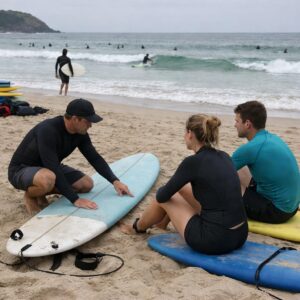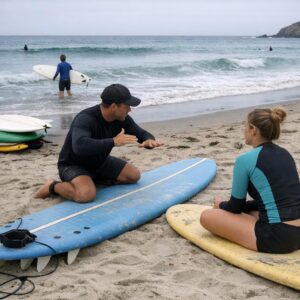
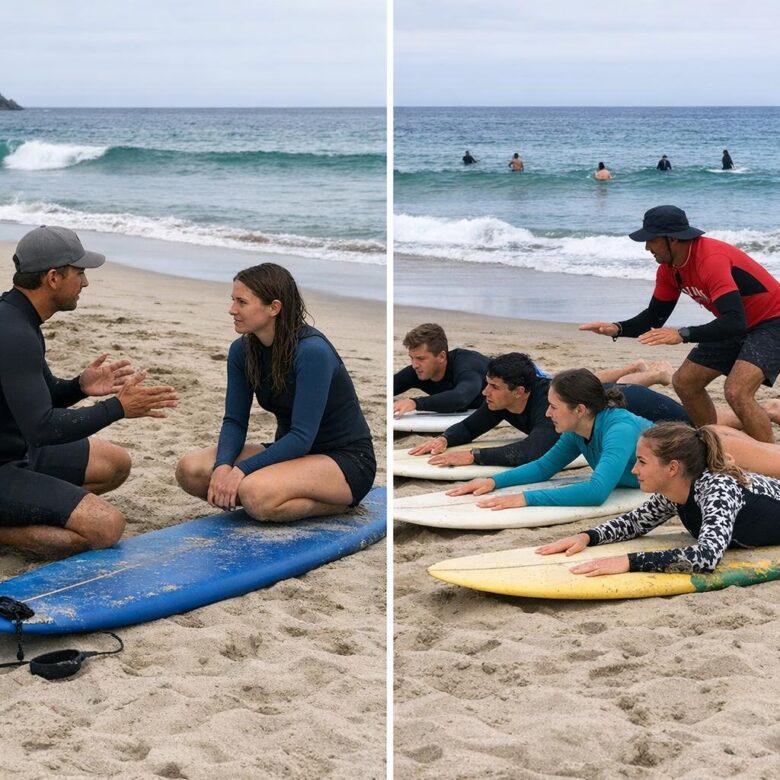
Picture two first lessons. In one, an instructor stays beside a single student and adjusts every attempt. In the other, five beginners laugh, wait their turn and learn the same foundation together. Either lesson could be excellent—or poorly run.
The words private and group describe how instructor time is shared. They do not automatically tell you whether the instructor is qualified, the conditions are suitable, the equipment is safe or the lesson plan matches the students.
The better choice depends on the attention you need, the people joining you, the conditions, your budget and the reason you are booking. This guide helps you compare the formats without pretending that one is always superior.
A small, well-managed group can be a strong introduction. A private lesson can be valuable when the instructor genuinely adapts the session to one student. A semiprivate lesson often provides a useful middle ground.
Private, group and semiprivate lessons serve different purposes
Answer these six questions before comparing prices
The real differences are more nuanced than “fast versus cheap”
| Decision point | Private lesson | Group class |
|---|---|---|
| Instructor attention | Usually concentrated on one student, allowing frequent corrections. | Shared among participants, so feedback may be shorter or less frequent. |
| Lesson pace | Can be changed according to one student’s confidence, fatigue and progress. | Often follows a pace that keeps the whole group involved. |
| Cost per person | Usually higher because instructor time is not shared. | Usually lower, although equipment and other fees may vary. |
| Social experience | More focused and sometimes quieter. | Can feel supportive, relaxed and enjoyable for friends or solo travelers. |
| Specific technique work | Easier to organize around one identifiable skill or repeated mistake. | Possible, but the instructor must also supervise the needs of others. |
| Waiting time | Potentially less waiting, depending on conditions and fatigue. | Students may wait while the instructor helps another participant. |
| Observation | Less opportunity to watch several beginners solve the same problem. | Watching classmates can help clarify explanations and common errors. |
| Suitability for children | Useful when a child needs individual pacing or close supervision. | Can work well in an age-appropriate class with suitable ratios and safeguards. |
| Progress guarantee | No guaranteed result; conditions, instruction and the student still matter. | No guaranteed result; a well-run group may outperform a poor private lesson. |
When a private surf lesson may be worth the extra cost
A private lesson makes the most sense when there is a genuine reason to individualize the session. Paying more only for the word “private” does not add value if the instructor delivers the same generic script used for every student.
The instructor can introduce the water gradually, repeat explanations and pause without worrying about delaying a larger class. Tell the school about your swimming confidence before booking so it can decide whether the lesson is appropriate.
Individual observation may help separate problems involving board position, paddling, wave timing, hand placement or stance. The goal should be specific rather than simply “improve faster.”
A private session can reassess basic control and confidence before you re-enter more demanding conditions. An instructor cannot provide medical clearance, so discuss health or injury concerns with an appropriate professional first.
Wave selection, positioning, etiquette and safe routes through the surf require close attention. Progression coaching should occur only in conditions suited to your demonstrated ability.
A school experienced in adaptive surfing may modify communication, equipment, assistance and session structure. Ask specifically about relevant instructor training, accessibility and the support team rather than assuming any private instructor is prepared.
Private does not automatically mean safer or better
Safety also depends on water-rescue training, local knowledge, equipment, judgment and whether the instructor is willing to cancel unsuitable conditions.
The ISA Surf Level 1 pathway includes supervised practical hours and requires a valid lifesaving or surf-rescue award. Local standards may use other recognized pathways.
More feedback can help, but wave conditions, equipment, fatigue, communication and opportunities for repetition still affect the session.
A valuable private lesson should adapt the goal, board choice, practice area, explanations and feedback—not merely remove the other students.
When a group surf class is the more sensible choice
Group classes are sometimes described as a budget compromise. That overlooks their real strengths. A suitable class can be a comfortable and effective introduction when students have similar needs and the instructor can supervise everyone properly.
A beginner group can introduce equipment, beach safety, prone riding and the basic takeoff without requiring the cost of individual coaching.
Some students relax when they see that other beginners also miss waves, lose balance and need repeated explanations. The shared atmosphere may reduce pressure.
A private group made up only of your party may offer a better balance than joining a larger public class. Similar experience and fitness levels make planning easier.
After receiving a proper introduction, additional small-group lessons can provide supervised practice without paying the private rate for every session.
Semiprivate lessons can solve the biggest trade-off
More attention without paying for a completely private session
A lesson for two or three compatible students can give the instructor enough time to observe each person while keeping the cost below a one-to-one booking.
This works best when the participants have similar swimming confidence, age, experience and goals. It may work poorly when one person wants an introductory whitewater lesson while another expects coaching on unbroken waves.
- Two adult first-timers
- Siblings of similar ages
- A couple at the same level
- Friends with matching goals
- A parent and older child when the school approves
Match the format to the student—not to a stereotype
The confident first-timer
A small group may offer everything needed for an introduction, provided the school explains the student-to-instructor arrangement and uses appropriate conditions.
The anxious beginner
A private or semiprivate lesson may allow more conversation and gradual exposure. The instructor should never pressure a student to enter unsuitable conditions.
The progressing surfer
A focused private session can be useful when the surfer can identify a specific goal, such as wave entry, positioning or controlled direction.
The family booking
A family-only group may be practical, but young children and adults should not automatically share one lesson plan. Ask about age limits, ratios and safeguarding.
Children need the right supervision, not simply a private label
A one-to-one lesson may be appropriate for a young or nervous child, but group classes designed specifically for children can also be safe and enjoyable when the school uses suitable ratios, qualified instructors and age-appropriate communication.
Parents and guardians should ask:
- What is the minimum age and swimming requirement?
- How many children are assigned to each instructor in the water?
- Are assistants present, and what are their responsibilities?
- Does the instructor regularly work with this age group?
- What safeguarding procedures and checks apply locally?
- Must a parent or guardian remain on the beach?
- How are allergies, medication and additional needs handled?
- What happens if the child becomes cold, frightened or tired?
Do not book a mixed adult-and-child class solely because it is cheaper. The teaching pace, equipment and supervision needs may be very different.
Compare the complete value, not just the advertised price
A higher price may include more—but not always
Private lessons generally cost more because the instructor is reserved for one student. That price is reasonable only when the service actually includes meaningful individualization and clear booking terms.
- Beginner-appropriate surfboard and leash
- Wetsuit or rash guard when needed
- Actual lesson and water-time duration
- Number of students per instructor
- Taxes and booking fees
- Beach, access or permit charges
- Transport to the teaching location
- Photos, video or technique review
- Cancellation and rescheduling conditions
- Any age, swimming or health requirements
Send these questions to the surf school before booking
A short message can reveal how clearly the business operates
- How many students are assigned to each instructor during the water portion?
- Which surf-coaching and water-rescue qualifications do instructors hold?
- Is the class restricted to complete beginners or mixed with progressing students?
- What equipment is included, and how is the board selected for each participant?
- How does the school adapt a private lesson to one student?
- Can friends or relatives book a semiprivate session together?
- How are children or students with additional needs accommodated?
- What happens if the tide, wind, waves or currents become unsuitable?
- How much of the advertised duration normally takes place in the water?
- What refund, credit or rescheduling policy applies?
A clear answer is more useful than a long sales pitch. Statements such as “all instructors are professionals” or “everyone stands up” do not explain qualifications, supervision or safety procedures.
For a broader check of the school, equipment and cancellation terms, see our guide to choosing a beginner surf lesson.
A mixed lesson plan may give you the best value
You do not need to choose one format permanently. Many learners benefit from changing formats as their needs change.
Build the foundation
Take a private, semiprivate or very small beginner lesson to learn the local safety process, equipment and basic board control.
Gain repetition
Join suitable group classes for supervised practice, provided the conditions and group level remain appropriate.
Correct a specific issue
Return to private coaching when you can identify a repeated problem or are preparing to progress into a new type of wave.
This approach is not a required formula. Some students are perfectly well served by several small-group lessons, while others need individual instruction from the beginning.
Warning signs apply to both lesson formats
- The school guarantees that every student will stand up or progress within a fixed number of lessons.
- A “private” lesson is quietly combined with unrelated customers after payment.
- The instructor cannot explain water-rescue training or the safety plan.
- The group size is unclear, unlimited or changed without notice.
- Complete beginners are mixed with advanced students at the same teaching point.
- The school refuses to postpone or relocate when conditions are unsuitable.
- Children are placed in a large mixed-age class without clear safeguards.
- Equipment appears damaged, poorly fitted or inappropriate for the student.
- The lesson skips the beach briefing and moves directly into the water.
- Important fees, cancellation terms or swimming requirements appear only after payment.
Which format should you choose?
Choose a private lesson when you need individual pacing, closer feedback, adapted instruction or focused work on one clearly defined skill.
Choose a group class when you want an affordable introduction, enjoy learning with others and have confirmed that the group is small, well supervised and appropriate for your level.
Choose a semiprivate lesson when two or three compatible students want more attention without paying the full one-to-one price.
The deciding factor should not be whether private coaching sounds more premium or group instruction sounds more fun. Choose the lesson in which the instructor can realistically supervise you, communicate clearly and change the plan when the ocean requires it.
Frequently asked questions
Do beginners learn faster in private lessons?
Some do because they receive more frequent feedback and the pace can be adjusted. However, private instruction does not guarantee faster progress. Instructor quality, equipment, suitable conditions, fatigue and practice opportunities remain important.
Is a group lesson safe for a complete beginner?
It can be when the class is designed for beginners, the group size suits the conditions, instructors have appropriate training and the teaching area is properly selected. Ask about the number of students per instructor before booking.
Is a private lesson necessary for a child?
Not always. An age-specific small group may be suitable. The decision should consider the child’s age, swimming confidence, communication needs, conditions and the school’s supervision and safeguarding procedures.
Can two friends share a private lesson?
Many schools call this a semiprivate or private-group lesson. It works best when both students have similar abilities and goals. Confirm the student-to-instructor arrangement and price before paying.
Should I book several lessons in advance?
Booking one initial session can help you evaluate the instructor, organization and format before purchasing a package. Review refund and rescheduling terms carefully, particularly when lessons depend on ocean conditions.
Is video analysis necessary for a beginner?
No. Clear in-person feedback is usually more important during an introductory lesson. Video can become useful for identifying repeated movements, but it should not reduce supervision or create extra pressure to perform.
Editorial and safety references
- International Surfing Association: surf instructor training and certification pathways
- International Surfing Association: Adaptive Surfing Instructor Program
- RNLI: surfing safety guidance
- Surfing England: wave-riding etiquette
Instructor qualifications, group limits, safeguarding rules, insurance requirements and surf-school standards vary by country and local authority. Confirm the requirements that apply at the destination where the lesson will take place.