A first surfboard should give you more opportunities to practise the skills you are currently learning. It should not be selected only because it looks similar to the boards used by experienced surfers.
The right choice depends on your body size, balance, paddling ability, local waves, transport, storage space and whether you are still learning in broken white water or beginning to catch unbroken waves.
There is no single length or volume that is correct for every beginner. Charts and online calculators can narrow the search, but they cannot see how you move, where you surf or which boards have already worked well during your lessons.
Use this buying order instead of starting with a size chart
Be honest about whether you still need assistance, catch white water alone or already select small unbroken waves.
Consider wave strength, crowd, water depth, entry route and how often suitable beginner conditions appear.
Rent or borrow an appropriate soft-top, longboard or fun-shaped board before comparing small differences.
Check construction, damage, fins, leash compatibility, storage, transport and the final cost.
Write down your actual beginner profile
A seller cannot recommend responsibly when the only information provided is your height. Prepare a more useful description before visiting a shop or contacting an online retailer.
Can you paddle and turn the board alone? Catch broken waves without a push? Complete a controlled takeoff?
Record your approximate height and weight, but also mention mobility, previous injuries and difficulty carrying long equipment.
Note the brand, model, length and volume when available, along with what felt stable or difficult.
Describe whether your practice area usually has gentle white water, weak small waves or faster and more powerful surf.
A frequently used board may justify a different construction and budget from a board used only during occasional vacations.
Measure the vehicle, doorway, elevator, rack and storage space before buying a board that may not fit safely.
A qualified instructor who has watched you surf can usually provide more relevant feedback than a generic calculator. Ask which board helped you catch waves independently and what change would be reasonable from that equipment.
Volume is useful, but it is not the complete answer
Surfboard volume is normally expressed in liters. It describes the total amount of space occupied by the board and helps compare flotation between models.
More volume can provide useful buoyancy, but two boards with the same number of liters may feel very different. One may distribute the volume through a wide nose and stable center, while another concentrates it in a shorter, more performance-oriented outline.
How much board is present
Useful for comparing flotation, but the number does not explain where the foam is placed or how the board behaves.
Glide and usable surface
A longer board can paddle and enter waves earlier, but length alone does not guarantee stability or suitability.
Side-to-side stability
A fuller, wider platform often feels steadier, particularly around the area where the surfer places the hands and feet.
Where flotation is located
Thickness under the chest, rails and tail changes paddling, balance and how easily the board responds to pressure.
Shape determines how the dimensions work together
A full nose and generous center area generally provide more usable platform than a narrow pointed outline. The tail shape also affects stability and turning, but beginners do not need to choose from tail terminology alone.
Rocker is the curve from nose to tail when the board is viewed from the side. Less rocker can improve glide in weaker waves, while more curve may suit steeper wave entry. Too little or too much for the conditions can make the board harder to use.
Rails are the edges of the board. Fuller rails can feel more forgiving, while thinner and sharper rails respond differently when the surfer begins turning with more control.
Channels, concaves and other bottom features can affect speed and turning, but they should not distract a first-time buyer from basic stability, wave entry and appropriate construction.
A beginner does not need to become a surfboard designer before shopping. The purpose of understanding these terms is to avoid choosing from length and volume alone.
Which type of board makes sense as a first purchase?
Large soft-top board
Often provides a stable platform and a more forgiving exterior for early lessons and whitewater practice.
Soft-top does not mean indestructible. Skin, seams, fins and internal construction still require inspection and proper care.
Beginner hard board or fun shape
May suit a learner who already catches waves independently and has tested a similar board under appropriate supervision.
The harder exterior increases the importance of board control, spacing and avoiding collisions.
Low-volume performance shortboard
Requires stronger paddling, more accurate positioning and faster movements than most new surfers have developed.
A short length does not make it easier simply because it fits in the vehicle or looks easier to carry.
Read our comparison of soft-top and hard-top surfboards before changing construction only because you have completed a few lessons.
Do not use a universal height-and-weight table as a final decision
Body size affects how much flotation and deck area may be useful, but it does not create a precise board size by itself.
| Factor | Why it matters | What to ask |
|---|---|---|
| Body weight | Affects how deeply the board sits and how much flotation feels comfortable. | Which tested board kept me supported without becoming impossible to control? |
| Height | Influences stance, reach and the ability to carry and turn a long board. | Can I carry this board safely and position myself correctly on it? |
| Paddling strength | Affects acceleration and the ability to enter waves without assistance. | Did I catch waves independently on this size during a lesson or rental? |
| Mobility | Shoulder, hip, knee and ankle movement can affect paddling and takeoff comfort. | Does the board allow a controlled movement without pain or excessive rushing? |
| Skill stage | A surfer moving beyond white water may need different handling from a first-time learner. | Am I buying for assisted rides, independent white water or small unbroken waves? |
| Local conditions | Weak, slow waves and steeper, faster waves reward different combinations of glide and control. | Which board category is regularly used by beginners at this particular beach? |
Match the board to the waves you will actually surf
The nearest famous surf spot may be irrelevant
Your first board should match the manageable practice area you can reach consistently. A design intended for fast, clean waves may be frustrating at a sheltered beach with weak white water.
At the same time, simply buying a larger board does not make powerful shore break, shallow reef or strong currents appropriate for a beginner.
- Usual wave strength
- Bottom type
- Safe beginner area
- Typical crowd
- Entry and exit route
- Seasonal changes
- Local school equipment
Use our guide on reading surf forecasts before choosing a beach, but remember that forecast data cannot replace local instruction or an assessment from shore.
New or used: which purchase is better?
Buying new
A new board usually provides clearer model specifications, retailer support and a known history.
- Easier to confirm construction and intended user level
- No hidden previous impact or amateur repair
- Possible manufacturer warranty
- Higher initial cost
- New does not guarantee that the model suits you
Buying used
A suitable used board can reduce the initial cost and make sense during the early learning phase.
- Lower purchase price in many markets
- May include fins, leash or bag
- Repairs and water entry may be difficult to identify
- Warranty may not transfer
- Professional inspection may be worth the cost
The best value is not automatically the cheapest listing. Add the likely cost of repairs, missing fins, leash replacement, transport and protective storage before comparing it with a new package.
How to inspect a used surfboard before paying
Inspect in bright, even light with the board dry
Closed surface marks
Minor scratches and shallow pressure dents may be acceptable when the skin remains sealed and firm.
Cracks, repairs and soft areas
These may be harmless, poorly repaired or structurally important. Ask an experienced repairer before assuming.
Open damage or loose structure
Exposed foam, loose fin boxes, delamination, major creases and repeated failed repairs can become expensive projects.
Do not buy a wet board straight from the ocean when you need to inspect its weight, seams and small cracks. Wax and traction pads can also hide deck damage.
Construction affects durability, repair and handling
Terms such as epoxy, polyester, EPS, polyurethane, molded composite and soft-top refer to different parts or methods of construction. Ask for the exact construction rather than assuming every hard board or foam board is made the same way.
Provides a softer exterior but may use different internal cores, skins, seams and fin systems. Follow the exact manufacturer’s care and repair guidance.
Common in modern constructions. Exposed EPS foam generally requires an epoxy-compatible repair rather than polyester resin.
A traditional construction with its own repair materials and feel. It is not automatically better or worse for every beginner.
May combine proprietary skins, rails, cores and laminations. Check warranty and repair instructions before modifying it.
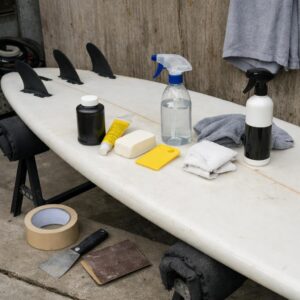
A durable board can still be damaged by heat, impact or water entering an open ding. Read our surfboard care guide before deciding how much maintenance a particular construction requires.
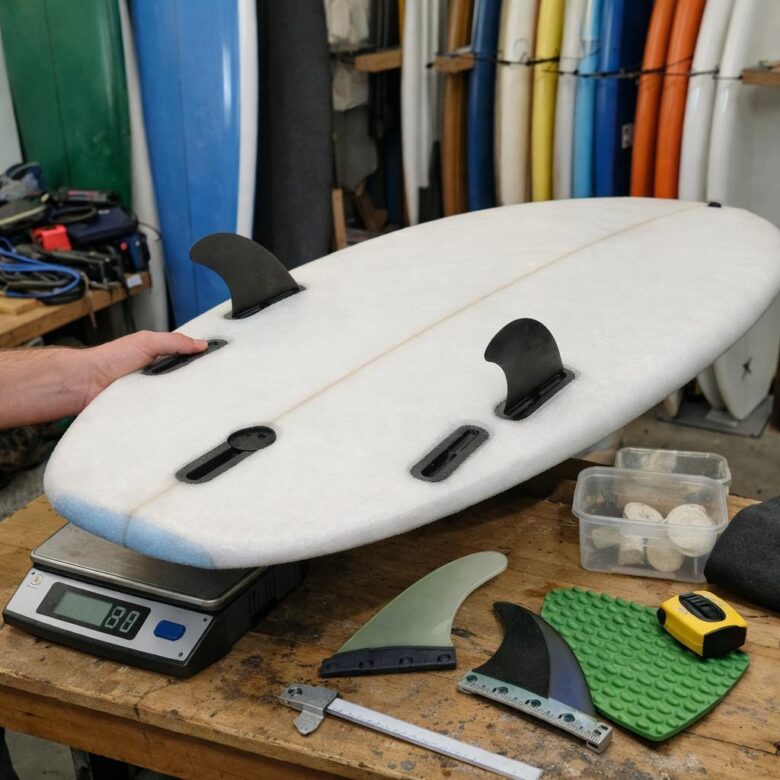
Check the fin system before assuming fins are included
Some boards have fixed fins, while others use removable systems. A listing that shows fins in the photograph does not guarantee that they are part of the sale.
Before paying, confirm:
- The number of fins required by the board
- The exact fin-box system
- Whether compatible fins are included
- Whether screws, plates or tools are included
- Whether any box moves or shows cracking
- Whether replacement fins are available locally
Beginners do not usually need to optimize several advanced fin configurations immediately. Secure, compatible fins in good condition are more important than collecting multiple performance templates.
The leash is separate safety equipment
Do not assume that an old leash included with a used board is still reliable. Inspect the cuff, cord, swivels, rail saver, string and attachment point.
Surfing England advises surfers to use an appropriate straight leash and ensure fins are securely installed. A leash helps reduce separation from the board, but it can fail and does not replace swimming ability or correct judgment.
Add the complete ownership cost
The advertised board price may represent only part of the amount needed to use and protect it.
- Compatible fins and installation hardware
- Suitable surf leash
- Wax or traction when required
- Board sock, day bag or padded travel bag
- Roof rack, pads and approved straps
- Initial repair or professional inspection
- Storage rack or protective supports
- Delivery or oversized transport charge
Rent or demo before making the final decision
A real session can answer questions that product descriptions cannot. Try to compare boards in similar, manageable conditions rather than using one calm lesson and one difficult day as a direct test.
Repeat a familiar board
Begin with the model or category already used successfully during lessons. This creates a useful reference.
Change one major variable
Try a slightly different length, volume or construction instead of comparing two completely unrelated shapes.
Record what happened
Note wave count, paddling, turning, takeoff stability, carrying difficulty and instructor feedback.
A board that feels slightly slower to turn may still be the better first purchase when it helps you catch substantially more waves with control.
Buying mistakes that often create regret
- Choosing the shortest board that supports your listed weight.
- Treating volume as the only important measurement.
- Buying a performance board because it is labeled forgiving.
- Assuming every soft-top model is designed for complete beginners.
- Ignoring whether the board fits the vehicle and storage area.
- Purchasing a wet used board without inspecting it dry.
- Accepting a repair without asking which materials were used.
- Forgetting the price of fins, leash, bag and transport.
- Buying according to a famous beach rather than your practice conditions.
- Moving to a smaller board after only one successful standing ride.
Questions to ask the shop or seller
Request clear answers before paying
- Who is this model designed for: a complete beginner, progressing learner or experienced surfer?
- What are the full dimensions and listed volume?
- How is the volume distributed through the outline?
- Which wave range and conditions does the manufacturer recommend?
- What is the exact core and outer construction?
- Which fin system does it use, and are compatible fins included?
- Is a leash included, and should it be replaced?
- Has the board been repaired, waterlogged or involved in a major impact?
- Can I inspect or test it before the sale becomes final?
- What warranty, return or exchange conditions apply?
When buying online, save the product description, dimensions, construction details, photographs, return policy and written conversation with the seller.
A practical final decision
Your first board should be large and stable enough to support useful repetition, but not so difficult to carry and control that it creates another problem.
Begin with equipment that has already worked during lessons. Compare volume together with length, width, outline and construction. Match the board to the manageable waves you can surf regularly.
When choosing between an exciting board and a familiar board that produces more independent waves, the familiar option is often the better first purchase.
Progress does not require replacing the board as quickly as possible. Move to a more demanding design when your current board limits a clearly demonstrated skill—not merely because you have owned it for a certain number of months.
Frequently asked questions
What length should a beginner surfboard be?
There is no universal length. Many beginners learn on relatively long, stable boards, but the correct choice also depends on width, volume, outline, body size, mobility, ability and local waves. Use a board tested during a lesson as your starting reference.
How many liters does a beginner need?
A fixed liters-per-kilogram rule cannot account for shape, volume distribution, conditions and skill. Use volume to compare similar beginner designs, then confirm the choice through instructor advice or a demo.
Is an eight-foot foam board suitable for every beginner?
No. It is a common lesson size, but a smaller learner, child, heavier adult or person with limited transport may need a different model. The exact width, volume and design also vary between eight-foot boards.
Should I buy a board immediately after my first lesson?
Not necessarily. Several rental sessions can show whether you enjoy surfing regularly and which equipment suits your body and local conditions. Buying too early may lock you into a board selected from very limited experience.
Is a used surfboard safe for a beginner?
It can be when the model is suitable and the board is structurally sound. Inspect it carefully for open damage, soft areas, loose boxes, failed repairs and signs of water entry. Seek professional advice when uncertain.
When should I move to a smaller surfboard?
Consider changing when you catch waves consistently, control direction, understand positioning and can explain what the current board prevents you from doing. Standing occasionally is not enough by itself.
Are hard boards always faster than soft boards?
Construction influences weight, stiffness and response, but speed also depends on shape, size, conditions and the surfer. A beginner who catches more waves on a suitable soft board may gain more useful experience than on an unsuitable hard board.
Equipment and manufacturer references
- Surfing England: suitable surf equipment, leashes, fins and wax
- Firewire Surfboards: construction, care, damage and repair compatibility
- Catch Surf: softboard care and handling guidance
- Futures Fins: surfboard fin systems and selection information
Dimensions, construction, repair materials, fin compatibility and intended skill levels differ between manufacturers and models. Check the specifications and instructions for the exact board before purchasing or modifying it.