Soft-top and hard-top surfboards are often presented as two steps in a fixed progression: begin on foam, then move to fiberglass. That description is convenient, but it leaves out an important fact.
The material covering the board is only one part of the decision. A long, wide soft-top lesson board and a short performance soft-top are very different. The same is true of a stable hard longboard and a narrow hard shortboard.
Your first purchase should be based on the complete design, your current control, the waves you regularly surf and the equipment that has already worked during lessons.
What soft-top and hard-top actually mean
Soft-top surfboard
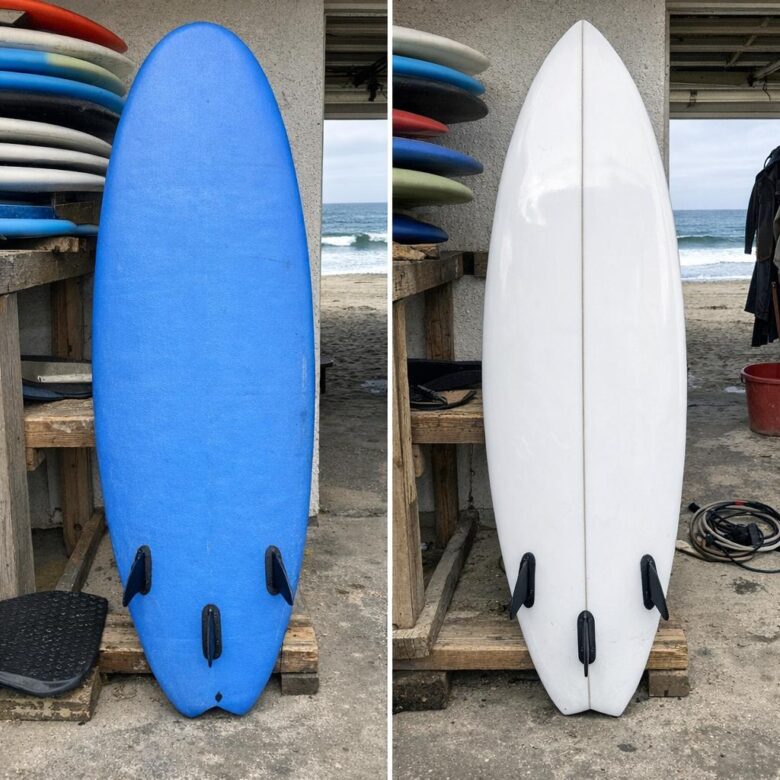
A soft-top has a padded or foam-like deck and usually a slick bottom skin. Internal cores, stringers, rails, fin systems and overall stiffness vary between brands and models.
- The deck is generally more forgiving during accidental contact.
- Large beginner models often provide generous width and volume.
- Some models use softer fins, while others use firmer performance fins.
- Short performance soft-tops are not automatically suitable for beginners.
Soft exterior does not mean harmless, indestructible or appropriate for every shore break, reef or crowded lineup.
Hard-top surfboard
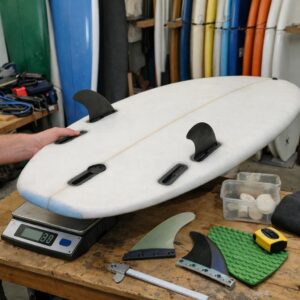
“Hard-top” is an informal category covering several rigid constructions, including polyurethane and polyester boards, EPS and epoxy boards, molded composites and other proprietary systems.
- A rigid surface can provide a more direct and responsive feel.
- Shapes range from stable longboards to demanding performance shortboards.
- Dings may expose the core and require construction-compatible repairs.
- The harder surface increases the consequences of poor board control.
Rigid construction does not automatically mean faster, more advanced, longer-lasting or better value.
How the two categories compare in real beginner use
| Buying factor | Soft-top | Hard-top |
|---|---|---|
| Accidental contact | The padded deck is generally more forgiving, although the board, fins and leash can still cause injury. | The rigid shell and sharper damaged areas can make impacts more serious. |
| Beginner stability | Often strong on large lesson-style shapes with wide outlines and generous volume. | Can also be stable when the board is a suitable longboard or fun shape. |
| Paddling and wave entry | Large models commonly provide useful glide and flotation in manageable beginner waves. | Depends heavily on length, rocker, volume and outline rather than the hard surface itself. |
| Turning response | Lesson models may feel slower to respond, while performance soft-tops can be much more reactive. | A rigid construction can provide clearer feedback, but only when the surfer can control the board. |
| Impact durability | Often tolerates small bumps well, but skins, seams, plugs and internal parts can still fail. | May resist normal use well but can crack, puncture or delaminate after impacts or heat exposure. |
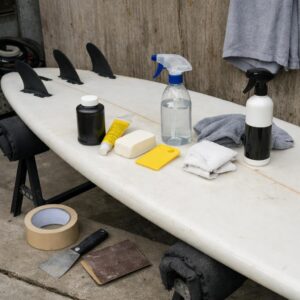
| Repair | Repair methods are often brand-specific and may involve skins, seams or special adhesives. | Repair materials must match the core and resin system; the wrong resin can damage exposed foam. |
| Maintenance | Needs rinsing, drying and protection from prolonged heat and sunlight. | Also needs rinsing, inspection, suitable storage and prompt repair of open dings. |
| Progression | Can remain useful for years, especially in weak waves or relaxed sessions. | May offer more precise control once the surfer has the ability to use that response. |
| Resale | Depends on brand, condition, size and local demand. Soft boards can hide water or seam damage. | Often has an established used market, but poor repairs and water entry can reduce value sharply. |
Is a soft-top automatically safer?
Where the softer exterior helps
A padded deck can reduce the severity of some accidental contact compared with a rigid fiberglass surface. This is one reason large soft boards are commonly used in beginner instruction.
- Falls during early whitewater practice
- Kneeling and repeated takeoff attempts
- Minor bumps while carrying the board
- Closely supervised beginner sessions
Risks the soft surface does not remove
A large soft-top still has weight and momentum. It can hit another surfer, pull through the leash or strike someone with its fins.
- Losing control in crowded water
- Throwing the board during a wave
- Surfing powerful shore break
- Using damaged or unsuitable fins
Surfing England advises surfers to use equipment suited to their ability, ensure fins are secure and use an appropriate straight surf leash. These checks apply whether the deck feels soft or hard.
Match the choice to your actual stage
You are still learning board control, paddling position, whitewater timing and a stable takeoff. A large beginner-oriented soft-top is usually the most practical reference because it combines a forgiving surface with a shape designed for repetition.
Usually start with a soft-topYou can catch broken waves without a push and finish most rides without losing the board. Continue with a soft-top when it still provides useful practice. Consider a stable hard board only after testing one in appropriate conditions.
Test before changingYou can paddle, turn, select manageable waves, follow basic priority and control your direction. A suitable hard funboard, mid-length or longboard may offer useful feedback, but moving to a small performance board is not required.
Choose by demonstrated skillProgress does not require replacing a soft-top on a schedule. Some surfers keep one because it performs well in weak waves, is useful for family sessions or provides a relaxed alternative to more demanding boards.
Do not let the top material hide an unsuitable shape
A short performance soft-top may be harder for a beginner than a long hard board. Compare length, width, volume, outline, rocker and intended skill level before comparing the exterior material.
Use the complete process in our beginner surfboard buying guide before relying on a simple soft-versus-hard label.
Three realistic buying situations
First lessons in gentle white water
A large soft-top similar to the lesson board is usually the lower-risk choice. Familiar equipment makes it easier to judge whether technique is improving.
Regular learner catching waves alone
A stable hard funboard may be appropriate after a successful demo. It should not reduce wave count dramatically or make board control unreliable.
Occasional vacation surfer
Renting may be better than owning either type. Storage, transport, repairs and using the wrong board at changing destinations can outweigh the purchase benefit.
When a hard-top becomes a useful progression choice
A hard board may be worth considering when you can explain what you want it to improve. “It looks more professional” is not a useful reason.
More relevant signs include:
Inspect a used soft-top differently from a used hard board
Inspect both boards dry and in good light
A cheap board becomes expensive when it needs structural repair, new fins, a replacement leash and transport equipment before the first session.
Care and repair are different for each construction
Soft-top care
- Rinse away salt and sand after use.
- Allow the board and cover to dry before long-term storage.
- Keep it away from prolonged heat and direct sunlight.
- Follow the brand’s instructions for seams, skins and adhesives.
- Do not assume a bodyboard repair product is compatible.
Hard-top care
- Inspect rails, nose, tail, deck, bottom and fin boxes.
- Do not return an open ding to the water.
- Identify the foam and resin system before repairing.
- Keep the board away from hot cars and prolonged direct sun.
- Use padded storage and avoid crushing the rails with straps.
Catch Surf advises owners to rinse and dry its soft boards, keep them out of prolonged heat and follow specific repair-product instructions. Firewire states that its EPS and epoxy boards must not be repaired with polyester resin and advises against using a damaged board in the water.
These examples show why repair advice must be matched to the exact board. Read our complete surfboard care guide before attempting a repair.
Compare the full cost of ownership
The purchase price alone does not show which option is cheaper.
- Compatible fins and hardware
- Suitable straight surf leash
- Wax or traction when required
- Board sock, day bag or travel bag
- Roof rack, pads and approved straps
- Repair materials or professional ding repair
- Indoor or padded storage
- Delivery and oversized transport fees
A soft-top may cost less initially but require replacement when a seam or skin is badly damaged. A hard board may have better resale in some markets but create an immediate repair bill after one open ding. Brand, construction, local repair access and condition matter more than a universal price rule.
Common mistakes in this comparison
- Assuming every soft-top is a beginner board. Some short soft boards are designed for experienced performance surfing.
- Assuming every hard board is difficult. A high-volume hard longboard can be more stable than a small soft-top.
- Moving to hard construction only to look more advanced. Appearance does not improve paddling, timing or control.
- Comparing boards by length alone. Width, volume, outline, rocker and stiffness change how that length behaves.
- Treating soft-top as impact-proof. Skins, seams, fins, plugs and internal cores can still be damaged.
- Believing a hard board always lasts longer. Heat, open dings, poor transport and incorrect repairs can shorten its life quickly.
- Buying for future ability. The better first board is normally the one that creates more controlled practice now.
- Ignoring the local beach. Board choice cannot make a powerful or hazardous location appropriate for a beginner.
Rent both categories before deciding
Use the familiar board
Repeat the soft-top or lesson board that has already helped you catch waves. Record how often you paddle into waves without assistance.
Try a comparable hard board
Choose similar overall stability rather than jumping directly to a much smaller shape. Use manageable conditions and qualified guidance.
Look beyond one successful ride
Consider wave count, paddling, board control, fatigue, carrying, repairs and how comfortable you felt around other water users.
A hard board that turns more sharply but cuts your wave count dramatically may not yet be a useful progression. A soft board that feels less responsive but allows consistent practice may still be doing the more important job.
Which one should you buy first?
Choose a beginner-oriented soft-top when you are still developing basic paddling, whitewater timing, balance and reliable board control.
Consider a stable hard-top when you already catch waves independently, understand basic positioning and have tested a similar board without losing most of your wave opportunities.
Keep renting when you surf infrequently, travel between different types of waves or still do not know which dimensions work for you.
Your first purchase does not need to be the board you keep forever. It needs to support the stage you are in now, fit the waves you can safely practise in and provide enough successful repetitions to keep learning.
Quick answers
Is a soft-top always the best first surfboard?
No. It is often the most forgiving option for a complete beginner, but the exact shape and size still matter. A small performance soft-top may be less suitable than a stable hard longboard.
When should I move from a soft-top to a hard board?
Move when you catch waves independently, control the board reliably and can identify a specific benefit from the new design. Do not change only because a certain number of lessons or months has passed.
Are hard-top surfboards faster?
Not automatically. Speed depends on shape, rocker, volume, fins, wave conditions and the surfer. A rigid construction may feel more responsive, but an unsuitable hard board can catch fewer waves.
Do soft-tops need wax?
Some do, while others have textured decks or brand-specific instructions. Check the manufacturer’s guidance for the exact model before applying wax.
Are soft-top surfboards maintenance-free?
No. They still need rinsing, drying, inspection and protection from prolonged heat and sunlight. Repairs may require products specified by the manufacturer.
Can I learn on a hard-top surfboard?
Yes, when the board is appropriately sized and the lesson is properly supervised. However, the rigid surface increases the importance of board control, spacing and suitable conditions.
Equipment and manufacturer references
- Surfing England: surf equipment, leash, fin and wax guidance
- Catch Surf: softboard care, heat, transport and repair guidance
- Catch Surf: example of a performance-oriented soft surfboard
- Firewire Surfboards: epoxy construction, care and repair compatibility
Surfboard materials, fins, repairs, intended skill levels and care requirements vary by model. Always check the specifications and instructions supplied for the exact board you are considering.