Surf-trip safety begins before the board bag is closed. The most important decisions concern the destination, medical access, insurance, instructor standards, transportation and whether the available waves genuinely match your current ability.
A beginner can arrive with excellent equipment and still be poorly prepared if no one knows where they are surfing, the emergency number is not saved, the rental leash is damaged or the only nearby break is beyond their experience.
This checklist is designed to help you create a safer plan without pretending that preparation removes every risk. Local authorities, lifeguards, qualified instructors and the conditions visible at the beach always take priority over a general online guide.
Start with an honest travel-risk profile
The destination should be selected around your current skills, not the skills you hope to develop after arriving. Write down the information below before comparing surf camps, hotels or flights.
Can you remain calm in moving water, swim without the board and follow instructions after an unexpected fall? Tell the surf provider honestly about limitations.
Record whether you still need assistance, catch broken waves independently or have begun catching manageable unbroken waves.
Consider relevant injuries, allergies, chronic conditions, recent surgery, pregnancy, prescribed medication and any issue affected by exertion, heat or cold.
Determine whether you understand the local waves, transport, language, emergency system, weather pattern and beach rules.
Identify qualified instruction, lifeguard coverage where available, suitable rentals, a travel companion and reasonable access to medical care.
Check whether you can move to a safer beach, reschedule a lesson or spend the day elsewhere when conditions become unsuitable.
Use three decision gates before booking
Is there suitable surf?
The destination should offer manageable teaching areas during your season, not merely one internationally known break.
Is support available?
Confirm qualified instruction, appropriate equipment, transport and a clear procedure when conditions change.
Can help be reached?
Know how emergency services work, where suitable medical care is located and whether evacuation could become necessary.
A remote surf destination is not automatically irresponsible, but it requires more preparation. Longer travel to medical care, limited communication and boat-dependent access can change the insurance, equipment and emergency plan you need.
Create an emergency card before departure
Do not depend on having mobile data, a charged phone or access to an online booking account. Keep essential information available offline and share it with someone who is not traveling with you.
The emergency number used at home may not work at your destination. Verify the number through an official government or local emergency-services source rather than copying it from an informal travel post.
Protect your documents without carrying everything to the beach
- Verify passport validity and entry requirements for every destination and transit country.
- Check visas, electronic authorizations and any onward-travel requirements.
- Keep copies of your itinerary, accommodation and transport confirmations.
- Store insurance details and emergency-assistance instructions offline.
- Leave a document copy and contact plan with a trusted person at home.
- Keep prescribed medication in suitable labeled packaging with required documentation.
- Use secure accommodation storage for documents you do not need during the session.
- Avoid hiding passports, keys or cash in an obvious place near the vehicle or beach bag.
Cloud storage can be useful, but it should not be your only backup. Lost devices, account lockouts and poor connectivity can prevent access when it is most needed.
Check travel medical and evacuation insurance carefully
Ordinary domestic health coverage may provide little or no protection abroad. Travel cancellation insurance, travel medical insurance and medical evacuation insurance are different products and may be sold separately or together.
- Is recreational surfing covered? Confirm lessons, independent sessions, guided surfing and every destination on the itinerary.
- Are exclusions based on wave type or location? Check reef breaks, remote islands, competitions, professional activity and areas under official warning.
- What medical expenses are included? Review deductibles, limits, direct-payment rules and whether you may need to pay first.
- Is medical evacuation included? Understand who authorizes evacuation and whether transport is limited to the nearest suitable facility.
- Is surf equipment covered? Check airline damage, theft, unattended equipment, depreciation and maximum item values.
- What records are required? Police, airline, medical, rental-company and original purchase documents may be necessary.
- Are pre-existing conditions addressed? Review the policy language and any deadlines for purchasing a waiver or additional cover.
- What assistance is available around the clock? Save the correct international contact number and instructions for obtaining approval.
Prepare your health plan for the actual destination
Travel-health needs depend on the country, season, accommodation, planned activities, medical history and access to care. Official destination pages can identify vaccines, medicines and health risks that may require preparation before departure.
Pre-travel consultation
Discuss the itinerary and surfing plans with an appropriate healthcare professional when destination-specific vaccines, medicines or personal health concerns apply.
Regular medication
Bring enough for the trip and reasonable delays. Check storage requirements and whether the medicine is restricted at the destination.
Heat and sun exposure
Use shade, suitable clothing, drinking water and correctly labeled sun protection. End the session when illness, confusion or unusual weakness develops.
Cold and fatigue
Use surfwear suited to the conditions and leave the water before shivering, reduced coordination or exhaustion affects board control.
Build a compact first-aid kit you understand how to use
A first-aid kit helps with initial care for minor problems. It does not replace trained responders, medical assessment or emergency services.
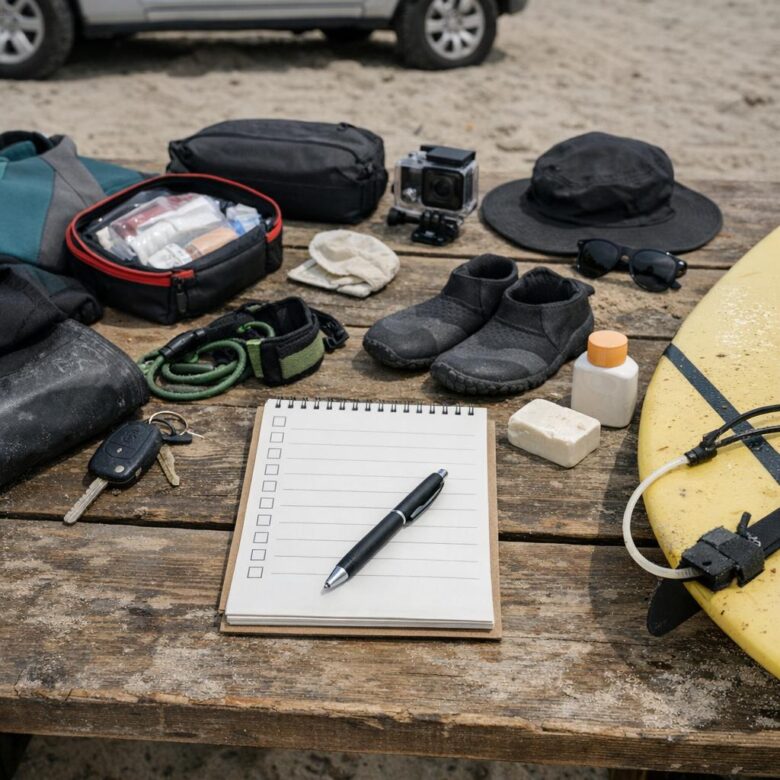
Basic travel-kit categories
Check expiry dates, damaged packaging and transport restrictions before departure. Keep the kit dry and accessible on shore rather than sealed beneath luggage or left in extreme heat.
Choose a surf provider with a visible safety process
The words “licensed,” “certified” and “professional” can mean different things between destinations. Ask which organization issued the qualification and what water-rescue training the instructor currently holds.
The International Surfing Association provides coaching and water-safety training pathways, but other recognized national or local systems may apply. There is no single universal instructor licence used at every destination.
Inspect rental equipment before accepting responsibility
Photograph existing damage when the rental agreement makes you responsible for the board. Ask the staff to record cracks, repaired areas, missing hardware or worn accessories before you leave the shop.
| Equipment | What to inspect | Reason to request a replacement |
|---|---|---|
| Surfboard | Rails, nose, tail, deck, bottom, seams, plugs and previous repairs | Open damage, exposed foam, loose structure, sharp edges or major deformation |
| Leash | Cuff, cord, swivels, rail saver, string and attachment | Cuts, hardened sections, broken stitching, damaged swivels or uncertain attachment |
| Fins | Correct installation, secure hardware and surrounding box or plug | Missing fin, movement, cracking, incompatible hardware or sharp damage |
| Wetsuit | Fit, zips, seams, large tears and suitability for the water | Painful restriction, major openings, failed closure or inappropriate thermal protection |
| Helmet or other protection | Fit, adjustment, visible damage and activity-specific instructions | Cracks, missing straps, poor fit or unknown impact history |
An old leash included at no charge is not automatically dependable. A large board is also not automatically appropriate if you cannot carry, turn or control it around other people.
Use the first 24 hours to reduce uncertainty
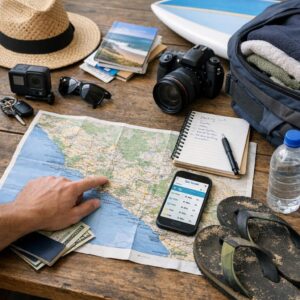
Test your phone, offline map, accommodation contact and emergency information before traveling to the beach.
Review current conditions, lesson location, equipment, transport and the plan if the forecast changes.
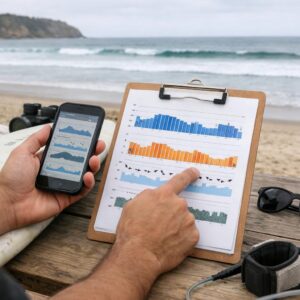
Observe sets, currents, access, crowd movement, designated areas and how the tide changes the shoreline.
Identify drinking water, secure storage, transport pickup, pharmacy access and the route to appropriate medical care.
Sleep, hydrate, eat and reassess your physical condition before committing to a demanding session.
Scan the complete beach before entering
Do not judge the session from one quiet minute or from the number of surfers already in the water. Watch several complete wave sets and the conditions between them.
Read official signs, flags, closures and environmental notices.
Compare the larger sets with your previous experience and current board control.
Look for channels, drifting surfers and water moving away from shore.
Check what may become exposed, submerged or inaccessible before your exit.
Identify a route that avoids riders, rocks, reef and crowded shallow water.
Choose more than one return point and confirm that it suits the changing tide.
Determine whether you have enough space to control a large beginner board.
Locate lifeguards, instructors, communication and the meeting point on shore.
Flag colors and designated areas vary between countries. Follow the signs and instructions used at the beach rather than assuming they match the system at home.
Understand rip-current basics before the trip
A rip current is not simply a large wave
Rip currents are channels of water moving away from the shoreline. They may occur near sandbars, river mouths, piers, groynes and other coastal features, and they can be difficult to identify without local knowledge.
Ask lifeguards or qualified instructors to point out current patterns before entering. A channel that looks calmer than the surrounding breaking waves may not be the safest place for a beginner.
- Stay as calm as possible.
- Keep hold of the board when you can.
- Do not exhaust yourself fighting directly against the current.
- Signal visibly and call for help.
- Follow local rescue guidance and lifeguard instructions.
The RNLI advises people caught in a rip to avoid swimming directly against it, stay with their board when they have one, signal for help and move parallel to shore when able to escape the current.
Know what to do when another person is in difficulty
Alert trained help
Contact lifeguards or the responsible local emergency service immediately. Clearly identify the location and person in difficulty.
Do not rush into a rescue you cannot perform
Entering moving water without rescue training or suitable equipment can place both people at greater risk.
Follow responder instructions
Keep pointing toward the person, communicate changes and use available shore-based assistance only as directed and safely possible.
Formal water-safety and first-aid training can improve your ability to respond, but a short online description cannot replace practical instruction.
Plan every session so someone knows where you are
The RNLI recommends surfing with another person and telling someone where you are going and when you expect to return. This is especially important at unfamiliar beaches.
Update the contact when you change beaches or extend the session. A plan that points to the wrong coastline is not useful.
Do not overlook risks away from the water
Use reputable transport, follow local licensing rules and wear appropriate restraints or protective equipment. Do not drive while exhausted after a long session.
Use a rack and straps approved for the vehicle and load. Recheck boards during the journey and never rely on improvised cords.
Follow destination-specific health guidance and use reliable food and water sources. Stomach illness and dehydration can quickly end a surf plan.
Use shade, clothing, labeled sun protection and regular hydration. Do not leave boards, medicines or electronics in extreme vehicle heat.
Carry only what you need, use secure storage and avoid leaving documents, phones or visible bags unattended in a vehicle.
Do not combine surfing, swimming, driving or unfamiliar coastal conditions with impaired judgment.
Run a final check before every session
- Official information checked Warnings, forecast, tide, beach signs and local instructions are current.
- Conditions match your ability The decision is based on larger sets and currents, not only the smallest waves.
- Equipment passes inspection Board, fins, leash and surfwear are suitable and free from significant damage.
- Entry and exit are identified You know how the changing tide may affect both routes.
- Someone knows the plan Your location and expected return time have been shared.
- You are physically ready You are not ill, injured, severely tired, dehydrated, cold or impaired.
- Help can be contacted The emergency number and meeting point are available offline.
- You have permission to stop Money, travel time and other surfers do not force you to enter.
Warning signs that should change the plan
- The only available break is beyond your demonstrated ability.
- The surf provider minimizes questions about swimming confidence or health.
- Instructor and rescue qualifications cannot be explained.
- The rental board, fins or leash have visible damage.
- No one knows where you are surfing or when you should return.
- You cannot identify the entry, exit or current pattern.
- The tide may remove the planned return route.
- Recent observations are larger or rougher than the forecast suggested.
- Lifeguards or local authorities advise against entering.
- You are relying on a phone connection that is not available at the beach.
- Travel fatigue, illness or dehydration is affecting concentration.
- You feel pressured to surf because the trip or lesson was expensive.
A safer trip is built around alternatives
Choose a destination with waves that match your current ability, qualified local support and a realistic route to medical help. Prepare travel documents, destination-specific health information, insurance and emergency contacts before departure.
Once you arrive, inspect the beach, rental equipment and your own physical condition. Surf with another person, share the session plan and follow the local lifeguard or instructor system.
The most important item on the checklist is the ability to stop. Moving to another beach, rescheduling a lesson or staying out can protect the rest of the trip and create a better opportunity later.
Frequently asked questions
Should a beginner surf alone while traveling?
Beginners should avoid surfing alone, particularly at an unfamiliar beach. Surf with another person, use qualified instruction when needed and tell someone where you are going and when you expect to return.
Does ordinary travel insurance cover surfing?
Not necessarily. Policies differ in their treatment of recreational surfing, equipment, remote locations, medical care and evacuation. Read the policy and obtain written clarification before purchasing.
Should I carry my phone into the water?
A beginner near shore normally benefits more from leaving a charged phone securely with a responsible person or in an accessible shore location. A consumer pouch may not protect every device or remain practical during a fall. Remote or offshore activities require communication equipment selected for that environment and local guidance.
Are reef booties enough to make a reef break safe?
No. Foot protection may reduce some cuts or improve grip, but it does not remove shallow reef, currents, difficult entries, powerful waves or limited exits. The break must still match your ability.
What should I do after discovering a damaged rental leash?
Do not enter the water with it. Show the damage to the provider, request a suitable replacement and make sure the attachment is correct before accepting the equipment.
Is a small first-aid kit enough for a remote surf trip?
A kit can support initial care but cannot replace medical access, trained responders or evacuation planning. Remote destinations require a more complete assessment of communication, transport, insurance and healthcare availability.
Should I surf immediately after a long flight?
Travel fatigue, poor sleep, dehydration and unfamiliar equipment can impair judgment and physical performance. Observe the beach, recover and begin with a conservative session or lesson rather than your most demanding plan.
Travel, first-aid and water-safety references
- U.S. Department of State: international travel checklist
- U.S. Department of State: travel medical and evacuation insurance
- CDC Travelers’ Health: preparation before travel
- CDC Travelers’ Health: adventure travel safety
- American Red Cross: basic first-aid kit contents
- RNLI: surfing safety checklist and equipment guidance
- RNLI: rip-current awareness and response guidance
- International Surfing Association: coaching and water-safety training pathways
Emergency numbers, beach flags, insurance terms, entry rules, health advice and instructor requirements vary by destination and can change. Verify them through the authorities and providers responsible for your actual trip.