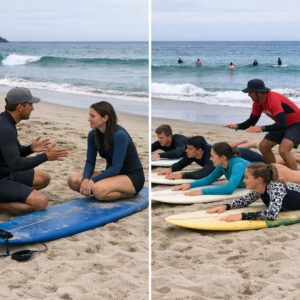
Learning to surf safely is not a race from the sand to unbroken waves. It is a sequence of smaller skills: understanding the beach, handling the board, catching controlled whitewater, finishing a ride, falling safely and recognizing when conditions have moved beyond your ability.
A beginner does not need perfect balance or exceptional fitness before taking a first lesson. You do need honest communication about swimming confidence, health concerns and previous ocean experience so the instructor can decide whether the session and conditions are appropriate.
This guide explains a practical learning order. It does not replace instruction from a qualified surf coach, lifeguard directions or a local assessment of the beach.
Check whether you are ready for a first lesson
You do not need to arrive as a strong competitive swimmer, but the surf provider needs accurate information about how you respond in water. Do not hide limitations because you are worried that the lesson may be changed or postponed.
Can you remain calm after submersion, move through shallow breaking water and follow instructions while wearing surf equipment?
Tell the instructor whether you regularly visit surf beaches or have never experienced waves, currents and changing tides.
Disclose injuries, medical conditions, medication, allergies or mobility limitations that may affect exertion, cold exposure or communication.
Ask for clarification when safety signals, boundaries or techniques are not understood. Do not copy another student and hope the meaning becomes clear.
Illness, dehydration, pain, poor sleep or exhaustion can make a beginner lesson more difficult than expected.
A relaxed first experience, vacation activity and long-term progression may require different lesson plans and booking choices.
Ask the provider about any swimming or age requirement before paying. Requirements differ between schools, locations and lesson conditions.
Learn in the right order
Begin with a school that can explain its coaching, first-aid and water-rescue standards. A responsible provider screens students and changes the lesson when conditions are unsuitable.
Read signs, identify the teaching boundary, observe several wave sets and learn where currents, rocks, swimmers and other surfers are located.
Learn how to carry the board, attach the leash, protect the fins and position the board safely around incoming whitewater.
Practise body position, turning toward shore, paddling and catching controlled broken waves before adding a takeoff.
Stand only after you can catch the wave in a stable position. A hurried takeoff cannot fix poor wave entry or incorrect placement on the board.
Stopping a ride, stepping off under instruction and protecting the head during a wipeout are skills—not afterthoughts.
Move into more demanding waves only after demonstrating board control, safe positioning, basic etiquette and the ability to return to shore.
Choose a lesson by its safety process
A colorful website and a promise that everyone will stand up do not reveal whether the session is responsibly managed.
The International Surfing Association provides coaching and water-safety pathways, while national organizations may operate other recognized systems. There is no single licence used by every surf school worldwide.
Use our guide to checking a beginner surf lesson before booking for a more detailed comparison.
Do not choose the beach from wave height alone
Descriptions such as knee-high or waist-high are imprecise and do not account for wave period, current, bottom shape, crowd, shore break or the learner’s ability. Small-looking surf can still contain strong water movement or an unsafe entry.
Check coastal warnings, weather, wind, swell and tide through the responsible local services. Then compare the forecast with the conditions visible at the beach.
Choose a lifeguarded beach when practical and follow its local flag, sign and designated-area system. Flag meanings are not identical in every country.
The beginner area should offer manageable broken waves, sufficient space and an entry and exit suited to the students and conditions.
Identify rocks, reef, groynes, jetties, river mouths, steep shore break, submerged objects and areas that become inaccessible with the tide.
A beginner needs enough space to control a large board without entering a busy advanced peak or a designated swimming area.
Our guide to reading surf forecasts explains why swell height, period, direction, wind and tide must be considered together.
Use equipment designed for the session and your ability
| Equipment | Beginner priority | Check before entering |
|---|---|---|
| Surfboard | A stable board with enough usable width and volume for controlled practice; a large soft-top is a common starting point. | No open damage, exposed internal material, loose fin mount or sharp edge. |
| Leash | A straight surf leash appropriate for the board and conditions, attached as instructed. | Cuff, cord, swivels, rail saver, string and attachment point are secure. |
| Fins | Compatible fins installed correctly; softer beginner fins may be used on some lesson boards. | No missing fin, loose hardware, cracking or sharp damage. |
| Wetsuit or surfwear | Fit and thermal protection suitable for the water, air, wind and lesson duration. | Normal breathing and shoulder movement remain comfortable. |
| Sun protection | Protective clothing, shade and correctly labeled broad-spectrum sunscreen as appropriate. | Application and reapplication instructions are understood. |
| Optional protection | A helmet, boots or other equipment may be advised by the provider for the learner or location. | Correct fit, condition and suitability for the specific activity. |
Surfing England advises using equipment suited to ability and a straight leash at least as long as the surfboard. A leash can fail and does not replace swimming confidence, supervision or suitable conditions.
See the beginner surfboard buying guide and the beginner gear checklist before purchasing equipment.
Listen to the complete beach briefing
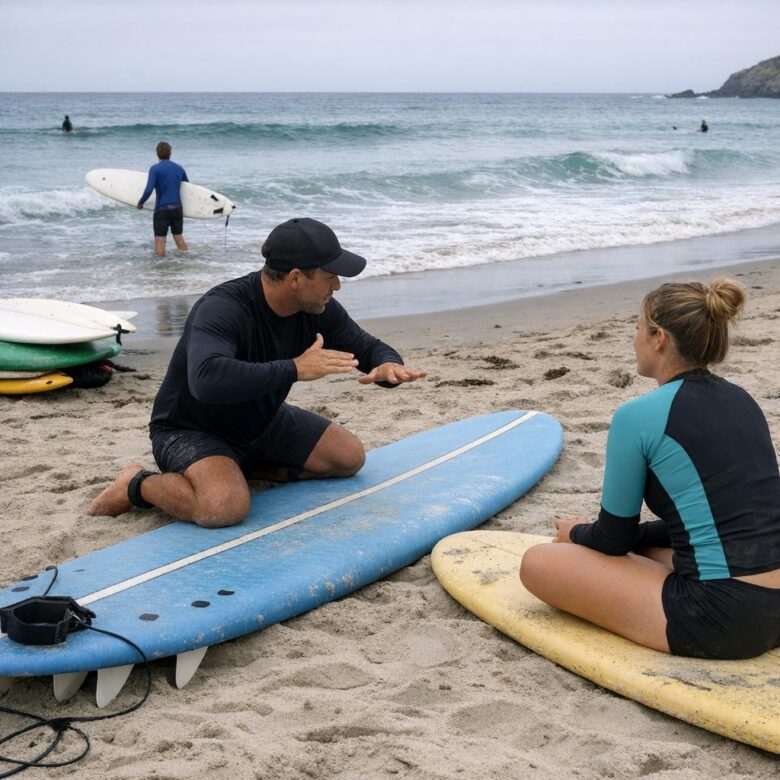
The briefing should happen before the class spreads across the beach or enters moving water. Ask questions while everyone can still hear the answer.
You should know all of these before entering
Learn board control before practising the pop-up
Carry and position the board
Hold the board securely without striking people, walls or vehicles. Keep the fins away from the body and do not drag them across the ground.
Follow the instructor’s orientation
Keep the board positioned so an incoming wave does not drive it into you or another student. The correct technique depends on the wave and water depth.
Check the path ahead
Do not begin when another learner, swimmer, board or obstacle is in the route toward shore.
Do not wrap the leash around fingers or hold it as a handle in moving water. Follow the instructor’s method for recovering and repositioning the board.
Catch controlled whitewater while lying down
Prone rides teach wave entry and board positioning without adding the timing and balance of standing. This is productive practice, not a failed version of surfing.
Use only the broken wave selected by the instructor and confirm that the route is clear.
Align the board without allowing it to turn sideways into another participant.
Lie centered enough to avoid repeatedly burying the nose or dragging the tail.
Use controlled strokes, look ahead and remain prone until the board is moving steadily.
Before standing, aim to repeat this sequence without being pushed, losing the board or drifting outside the lesson area.
Practise a pop-up that preserves control
The best technique is one your body can repeat safely
Surf instructors may teach different takeoff methods according to mobility, age, board size and lesson goals. Some learners use one continuous movement, while others initially use a staged technique.
Practise on a suitable surface with the board stable and the fins protected. Avoid forcing the knees, hips or shoulders into a painful movement.
The pop-up should be added after the wave has been caught. Standing too early can slow the board, move weight forward unpredictably or cause an immediate fall.
- Hands near the chest
- Eyes toward the travel path
- Feet under the body
- Knees relaxed
- Weight centered
- Arms used for balance
- No staring at the feet
Surfing England recommends learning the pop-up with a qualified instructor and beginning on a larger, more stable board, commonly a soft-top.
Learn how to finish a ride and wipe out
A controlled finish
- Look ahead for shallow water, people and obstacles.
- Slow or finish the ride using the method taught during the lesson.
- Avoid jumping from a fast-moving board into uncertain depth.
- Return to the board before beginning another attempt.
- Move out of the next learner’s route.
During an unexpected fall
- Avoid diving headfirst into shallow or unknown water.
- Protect the head and face with the arms while underwater and surfacing.
- Do not assume the board is directly above or behind you.
- Remain aware of other boards and incoming waves.
- Recover the board calmly and follow the instructor’s signal.
Understand rip-current response before independent practice
A rip current is water moving away from shore
Rip currents are associated with breaking waves and can occur at many types of surf beach. They are not always easy to identify, and a calmer-looking channel may still contain fast-moving water.
Beginners should ask a lifeguard or qualified instructor to identify current patterns at the actual beach. Do not intentionally use a rip as a route to deeper water because experienced surfers appear to be doing so.
- Stay as calm as possible.
- Keep hold of the surfboard when you can.
- Do not exhaust yourself paddling directly against the current.
- Signal and call for help.
- Move parallel to the shoreline or current when able.
- Return toward shore after leaving the strongest flow.
Actual escape options depend on the current, waves and location. Follow lifeguard instructions and local safety guidance rather than memorizing one maneuver as a guaranteed solution.
Learn etiquette before entering a busy lineup
Whitewater practice should normally take place away from a crowded advanced peak. Once you begin sharing unbroken waves, etiquette becomes an important part of collision prevention.
- Do not take off in front of a surfer already riding the wave.
- Do not repeatedly paddle around others to claim the priority position.
- Look toward the peak before committing to a wave.
- Avoid paddling directly through the path of a riding surfer.
- Communicate direction when another surfer may be affected.
- Maintain control of the board and leave enough space for mistakes.
- Do not monopolize waves simply because a large board catches them earlier.
- Move to a quieter appropriate area when the peak is beyond your level.
The surfer closest to the breaking part of the wave generally has priority, but local wave shape and established rotation can add complexity. Observe and ask for guidance before joining an unfamiliar lineup.
Know when the session should end
Beginners often notice fatigue only after technique and judgment have already deteriorated. Finish while you can still return to shore and manage the equipment reliably.
- Paddling strokes have become weak, irregular or poorly controlled.
- You repeatedly lose the board or cannot hold it safely in whitewater.
- Cold causes persistent shivering, numbness or reduced coordination.
- Pain changes your paddle, stance or ability to stand.
- You cannot follow the instructor’s signals promptly.
- The wind, tide, crowd or wave sets have changed noticeably.
- You have drifted outside the agreed practice area.
- Anxiety or panic prevents calm decision-making.
- The leash, fin, board or wetsuit develops a problem.
- A lifeguard or instructor asks you to leave the water.
Ending a session early is not wasted money or failed progress. It protects the quality of the next session and prevents tired repetitions from becoming bad habits.
A practical plan for your first five sessions
This is an example of skill order, not a promise that every surfer will progress on the same timetable. Repeat a stage whenever control is inconsistent.
Learn the beach boundary, equipment, board handling, recall signal, prone position and controlled whitewater rides.
Practise choosing a suitable broken wave, turning toward shore, paddling and catching it without an instructor pushing the board.
Add the pop-up only after stable wave entry. Focus on control, body position and a safe finish rather than ride length.
Begin small changes of direction where appropriate, maintain awareness of other students and improve recovery after a fall.
Ask the instructor which skills are reliable, which conditions remain suitable and whether supervised progression toward unbroken waves is appropriate.
Use skill gates instead of rushing to a smaller board
Whitewater independence
You can catch selected broken waves without a push, remain centered and finish the ride without sending the board toward others.
Environmental awareness
You can describe the practice boundary, drift, entry, exit, hazards and reason the instructor selected that area.
Supervised progression
You can control direction, follow priority rules and return to shore before considering small unbroken waves with appropriate coaching.
Do not replace a stable board only because standing has become easier. Move to a more demanding design when an instructor can identify a specific skill that your current equipment genuinely limits.
Keep a short record after each lesson
Start with control, not intensity
A safe beginner pathway begins with qualified instruction, a suitable beach and equipment selected for your current ability. Learn the briefing, board handling, prone wave entry and safe finish before treating standing as the main goal.
Progress by repeating manageable skills. Observe the beach again whenever the wind, tide, crowd or wave sets change. Surf with another person, tell someone your plan and leave the water before fatigue or cold affects control.
The ocean does not become safer because the lesson is paid for, the forecast looked good or other surfers are outside. Waiting, relocating or returning to instruction can be the correct next step.
Frequently asked questions
Can I teach myself to surf without a lesson?
Some people begin independently, but a qualified lesson can explain local hazards, equipment, board control, wipeout technique and lesson boundaries in a way that general online content cannot. Instruction is especially valuable for first-time surfers and unfamiliar beaches.
What wave height is safest for a beginner?
No single height is universally safe. Wave period, power, current, bottom shape, tide, shore break, crowd and ability also matter. Begin in the controlled area and conditions selected by a qualified instructor.
Should a beginner always use a soft-top surfboard?
A large, stable soft-top is a common and forgiving starting point, but the complete shape, volume, condition and fit for the learner still matter. Use equipment recommended for the actual session.
How deep should a beginner walk into the water?
There is no universal depth. Follow the instructor’s boundary because beach slope, wave power, current and the learner’s height vary. Do not move farther out simply because another student does.
Should I hold onto the board during every wave?
Maintain control when it is safely possible and follow the technique taught for the conditions. Do not place yourself in a dangerous position solely to prevent releasing the board. Spacing and instructor supervision are essential.
What should I do if I am caught in a rip current?
Stay calm, keep the board when possible, avoid exhausting yourself by moving directly against the strongest flow, signal for help and move parallel to the shoreline or current when able. Follow local lifeguard guidance.
When am I ready to catch unbroken waves?
Readiness is demonstrated through independent wave entry, board control, safe falling, environmental awareness and basic etiquette. Ask a qualified instructor to assess you in suitable conditions.
Beginner surfing and ocean-safety references
- RNLI: surfing safety, equipment, forecasts and surfing with another person
- Surfing England: beach signs, hazards, lifeguards and changing conditions
- Surfing England: boards, wetsuits, fins, wax and surf leashes
- Surfing England: beginner board selection and pop-up instruction
- Surfing England: surf etiquette and crowded-lineup guidance
- U.S. National Weather Service: rip currents and beach hazards
- International Surfing Association: coaching and water-safety pathways
Beach flags, instructor standards, emergency procedures and local hazards vary by country and location. Follow the authorities, lifeguards and qualified instructors responsible for the beach where you are learning.