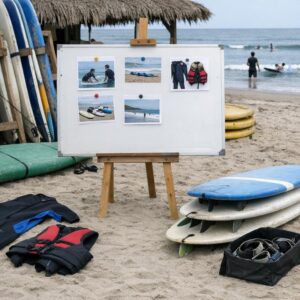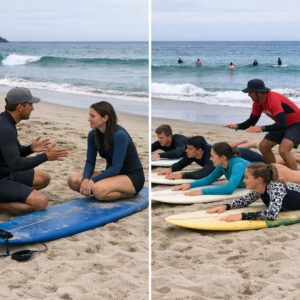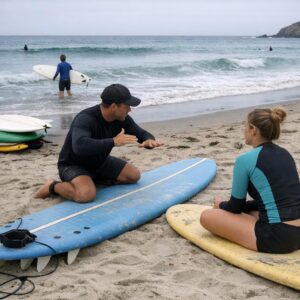
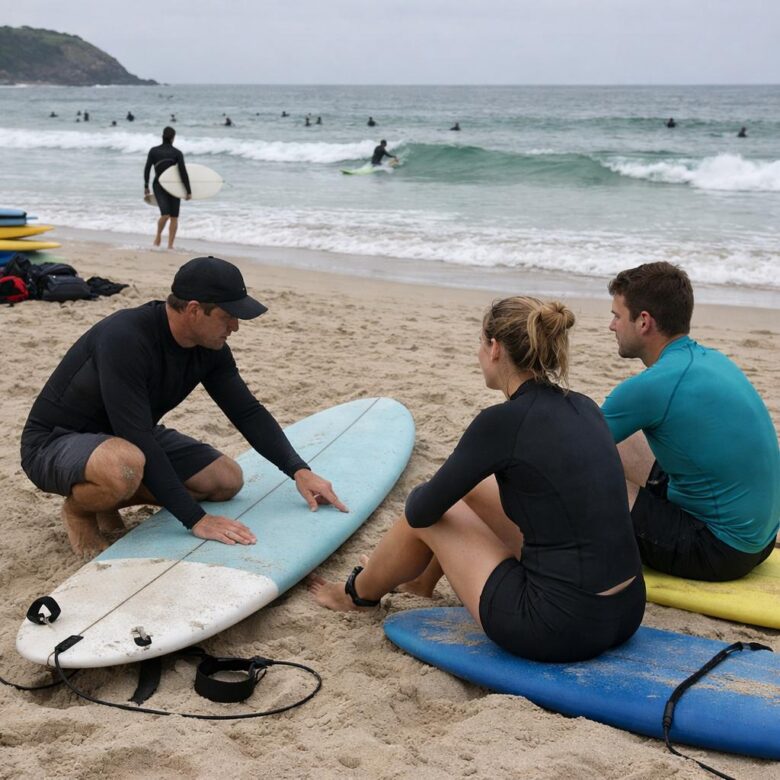
There is no reliable universal deadline. Progress depends on the conditions, frequency of practice, equipment, coaching, swimming confidence, physical recovery and what you personally mean by “learning to surf.”
First decide what “learning to surf” means
Surfing is not one isolated movement. It combines ocean awareness, swimming confidence, board handling, paddling, timing, balance, decision-making and awareness of other water users.
This is why two people can give very different answers to the same question. One person may consider a successful assisted whitewater ride to be “surfing.” Another may mean independently catching unbroken waves and riding across the open face.
A more useful way to measure progress is to ask which tasks you can perform safely and repeatedly.
- Carry and control the board without putting others at risk.
- Identify the lesson area and understand the instructor’s signals.
- Enter and leave the water through an appropriate route.
- Position your body correctly for paddling and wave entry.
- Catch manageable broken waves without being pushed.
- Stop or leave the board with reasonable control.
- Complete a stable takeoff without relying on the knees.
- Recognize when conditions are beyond your ability.
The first four or five skills may develop before a consistent standing ride. That does not mean the session was unsuccessful. They are part of becoming a safer surfer rather than simply producing one photograph of a takeoff.
A realistic progression through the beginner stages
The stages below are not deadlines. A surfer may move forward, return to an earlier skill in different conditions, or spend longer at one stage because of limited access to suitable waves.
Stage 1: Orientation and board control
First lessonsYou learn the parts of the board, safe carrying, the lesson boundaries, entry and exit methods, recall signals, falling technique and the basics of body position.
A first session may include prone rides or assisted standing attempts, but the more important outcome is understanding how to participate without losing control of the board.
Stage 2: Catching broken waves independently
FoundationYou begin selecting manageable whitewater waves, paddling at the correct moment and maintaining enough board speed to ride without an instructor pushing you.
At this stage, consistency matters more than one successful attempt. You should be able to repeat the setup while remaining aware of people in front of you.
Stage 3: A repeatable takeoff and controlled ride
Developing controlThe goal moves from simply reaching your feet to standing in a balanced position, looking in the intended direction and stopping before colliding with the beach, another student or an obstacle.
This stage may feel slow because paddling, wave timing and foot placement must work together. Practising only the pop-up on land will not solve poor wave entry.
Stage 4: Moving beyond white water
ProgressionWith appropriate supervision, you learn positioning, paddling through waves, selecting small unbroken waves and taking off before the wave has fully broken.
This is a meaningful jump in difficulty. The surfer must understand priority, avoid paddling into another person’s path and know how to leave the wave safely.
Stage 5: Early independence
Ongoing learningYou can choose conditions that match your ability, recognize obvious hazards, catch suitable waves without assistance and follow the local rules of the lineup.
Independence does not mean being ready for every beach. Experienced surfers continue adjusting to new breaks, larger waves, currents, crowds and equipment.
How practice frequency changes the learning process
Regular exposure usually makes it easier to remember positioning, timing and safety routines. Long gaps can mean spending part of each session rebuilding confidence and paddle fitness.
However, surfing more often is helpful only when the conditions are appropriate and your body has recovered. Repeating unsafe sessions in waves beyond your ability does not create useful progress.
| Practice pattern | What commonly happens | Useful expectation |
|---|---|---|
| One lesson during a vacation | You may experience the basic movements and complete assisted rides. | Treat it as an introduction rather than proof that you can surf alone. |
| Occasional sessions with long gaps | Confidence and paddling comfort may need to be rebuilt each time. | Repeat the safety and whitewater foundations before moving farther out. |
| Regular weekly practice | Skills are easier to reinforce, although unsuitable surf can interrupt progress. | Measure consistency across several weeks rather than expecting a fixed deadline. |
| Several appropriate sessions per week | You receive more opportunities to adjust timing and wave selection. | Include rest and avoid paddling out simply to meet a schedule. |
| Intensive surf camp | Frequent coaching can produce quick corrections, but fatigue may reduce learning. | Choose a program that adapts water time to ability and recovery. |
A beginner with access to gentle waves and regular coaching may reach independent whitewater rides relatively quickly. Someone learning in inconsistent, crowded or powerful beach-break conditions may need much longer despite putting in the same number of sessions.
For this reason, counting successful decisions and controlled waves is more informative than counting calendar days.
Eight factors that influence how quickly you progress
Wave quality
Small, manageable and predictable waves provide more useful repetitions than chaotic conditions that require constant survival decisions.
The board
A stable beginner board with suitable volume generally makes paddling, wave entry and balance easier than a narrow performance board.
Instruction
Qualified feedback can identify whether the problem is timing, body position, board choice or wave selection instead of guessing.
Swimming confidence
Comfort in moving water affects decision-making. A nervous or weak swimmer should disclose this before a lesson and follow the school’s requirements.
Practice consistency
Regular suitable sessions usually reduce the amount of time spent relearning basic board position and timing.
Physical recovery
Surfing uses unfamiliar paddling and stabilization movements. Excess fatigue can reduce control and encourage poor technique.
Crowd level
A crowded lineup reduces safe opportunities and adds decisions about priority, positioning and collision avoidance.
Fear and confidence
Confidence grows through manageable exposure. Pressure to paddle into conditions that feel overwhelming can delay rather than accelerate learning.
Why a suitable beginner board saves time
A common mistake is choosing a board according to appearance instead of suitability. A short, low-volume board generally requires stronger paddling, more accurate positioning and faster movements.
Beginner lessons commonly use larger soft-top boards because they offer more stability and are more forgiving during early practice. The appropriate dimensions still depend on the surfer’s size, mobility, experience and local conditions.
There is no single board length that is automatically correct for every beginner. Rather than assuming that all learners need the same eight-foot board, ask an instructor or reputable surf shop to consider:
- Your approximate weight and height.
- Your swimming and paddling confidence.
- The type of waves where you will practise.
- How easily you can carry and control the board.
- Whether the board is for lessons or independent use.
- The board’s overall volume, width and construction.
Moving to a smaller board too early can reduce your wave count and make it harder to identify whether the problem comes from technique or unsuitable equipment.
Common habits that slow beginners down
- Judging progress only by standing up. Board control, wave selection and safe exits are equally important.
- Practising in waves that are too difficult. More powerful surf does not automatically create faster improvement.
- Using equipment designed for advanced performance. A board that catches few waves gives you fewer useful repetitions.
- Ignoring the conditions. Tide, wind, current, wave shape and crowds can change the difficulty of the same beach.
- Copying the position of experienced surfers. Sitting near advanced surfers without understanding priority can create collisions and conflict.
- Paddling out alone too early. A beginner should not confuse completing a lesson with being ready to assess an unfamiliar beach independently.
- Repeating a faulty movement without feedback. More repetitions help only when you understand what you are trying to correct.
- Surfing while exhausted. Fatigue reduces paddling strength, reaction time and board control.
A practical plan for your first phase of learning
Learn the local signals, safe board handling, entry and exit method, falling technique and lesson boundaries.
Work toward catching broken waves without a push before focusing only on the standing movement.
Aim for stable hand placement, an efficient movement and a balanced stance rather than maximum speed.
Look ahead, keep space around the board and finish the ride before reaching people in shallow water.
Moving toward unbroken waves introduces new positioning, paddling, etiquette and hazard-management skills.
Do not treat success on one calm day as permission to surf every tide, swell or unfamiliar beach.
Our guide to choosing a beginner surf lesson explains how to check instructor standards, equipment, group size and cancellation policies before paying.
You can also review our step-by-step beginner safety guide before planning independent practice.
Track skills instead of counting days
A simple session note can reveal progress that is easy to miss. You do not need a smartwatch, balance trainer or expensive camera to understand whether you are improving.
Filming from the beach can be useful when done safely and with permission, but video is optional. It should not distract the surfer, instructor or person recording from hazards and other beach users.
How to know when you are ready for unbroken waves
Reaching your feet repeatedly in white water does not automatically mean you should paddle into an active lineup.
Before progressing, you should be developing the ability to:
- Paddle and turn the board without assistance.
- Catch broken waves consistently.
- Control the direction and end of a ride.
- Protect your head and avoid throwing the board.
- Understand basic priority and collision avoidance.
- Return through white water using an appropriate route.
- Recognize the instructor’s recall signals.
- Accept when the conditions are unsuitable.
A progression lesson can introduce these skills in a controlled way. The instructor should select the location according to the group’s ability rather than taking beginners directly into a crowded peak.
Safety remains part of the learning timeline
The RNLI recommends learning through an accredited training centre or recognized school, following lifeguard advice, surfing with another person and choosing conditions that match your ability.
Flag systems and designated surfing areas vary by country and beach. Follow the signs and instructions where you are surfing rather than assuming that every location uses identical colors or boundaries.
Before entering the water:
- Check the local weather, tide and surf conditions.
- Ask lifeguards about hazards when they are available.
- Inspect the board, fins and leash for damage.
- Tell someone where you are going and when you expect to return.
- Avoid surfing alone, particularly as a beginner.
- Stay out when the conditions exceed your ability.
If you are caught in a rip, local rescue guidance commonly advises staying calm, keeping hold of the board when possible, avoiding a direct fight against the current and signaling for help. Follow the emergency guidance issued by the coastal authority responsible for your location.
The most useful answer for a beginner
There is no honest way to promise that you will learn surfing in three lessons, one month or a particular number of hours.
A first lesson may be enough to experience a standing ride. Becoming capable of catching waves without assistance, controlling the board, understanding priority and selecting appropriate conditions usually requires far more repetition.
Focus on the next safe milestone:
- Control the board before trying to look advanced.
- Catch waves independently before moving farther out.
- Make your takeoff consistent before choosing a smaller board.
- Learn etiquette before entering a busy lineup.
- Build ocean judgment before calling yourself independent.
- Choose suitable sessions instead of rushing a deadline.
The surfer who knows when not to enter the water is progressing too. Good judgment is not separate from surfing ability; it is one of its most important parts.
Frequently asked questions
Can I learn to surf in one day?
You can learn introductory safety, board handling and takeoff movements in one day, and you may complete an assisted ride. One day is not normally enough to become an independent surfer who can assess conditions and catch unbroken waves safely.
How many lessons should a beginner take?
There is no universal number. One lesson can provide an introduction, while additional lessons may help with independent wave catching, takeoff consistency, unbroken-wave progression and etiquette. Base the decision on demonstrated skills rather than a package size.
Is surfing harder for adults?
Adults can learn successfully, but mobility, fitness, fear, previous injuries and available practice time vary widely. A suitable board, manageable conditions and instruction adapted to the individual matter more than comparing ages.
Do strong swimmers learn surfing faster?
Swimming confidence can help with comfort and safety, but it does not automatically provide wave timing, paddling technique, board control or etiquette. Strong swimmers still need surf-specific instruction.
Should I practise the pop-up every day?
Short land practice can help you understand the movement, provided it does not cause pain or reinforce an unsuitable technique. Surfing progress also depends on paddling, positioning and wave selection, which cannot be learned fully on land.
When should I buy a smaller surfboard?
Do not move down only because you can stand occasionally. Consider a smaller board after you can catch waves consistently, control your direction and understand how reduced volume will affect paddling and stability. Seek advice based on your size and local waves.
Editorial and safety references
- International Surfing Association: coaching and instructing courses
- Surfing England: beginner surf lesson plan
- Surfing England: beginner pop-up guidance
- Surfing England: wave-riding etiquette
- RNLI: surfing safety guidance
- RNLI: rip-current safety guidance
Surf-school standards, beach flags and emergency procedures vary between countries. Confirm local guidance before entering the water.