A wetsuit that is too loose can allow repeated cold-water flushing. One that is too small can restrict paddling, breathing and the movements needed for a controlled takeoff. Thickness matters, but it cannot correct a poor fit.
The right suit also depends on more than the water-temperature number shown by an app. Wind, air temperature, session length, wave activity, personal cold tolerance and the suit’s seams and internal lining can change how warm the same thickness feels.
This guide focuses specifically on wetsuits for recreational surfing. Diving, triathlon, swimming, kayaking and other activities may use different cuts, features and safety requirements.
Describe your normal surf session before choosing a thickness
Buying for the coldest temperature ever recorded in your region may produce an unnecessarily heavy suit. Buying for one unusually warm afternoon may leave you underprepared for most of the season.
Use a reliable local marine observation or forecast service. Check the seasonal range rather than one isolated reading.
Cold air and strong wind can make waiting between sets and returning to shore feel considerably colder.
A short supervised lesson and a two-hour independent session do not create the same thermal demand.
Two surfers in the same water may prefer different equipment. Use previous sessions rather than pride as your reference.
Continuous paddling creates more heat than sitting through long intervals, but fatigue can also make it harder to stay warm.
Ask established surf schools or shops what is normally used at that coast during your planned season.
What 3/2, 4/3 and 5/4 actually describe
The numbers generally describe different material thicknesses used across the suit. In a 4/3, thicker panels are normally placed around the torso and thinner panels are used where more flexibility is needed.
The exact panel map varies by manufacturer and model. One brand may use the second thickness mainly through the arms, while another also uses it through parts of the legs.
A three-number label such as 5/4/3 indicates three thickness zones. Read the specifications for the exact suit instead of assuming every brand places those materials identically.
Thicker insulating foam normally provides more warmth but also tends to add weight and reduce flexibility. Materials, internal linings and panel design can make two suits with the same listed thickness feel different.
Use water-temperature charts as starting references
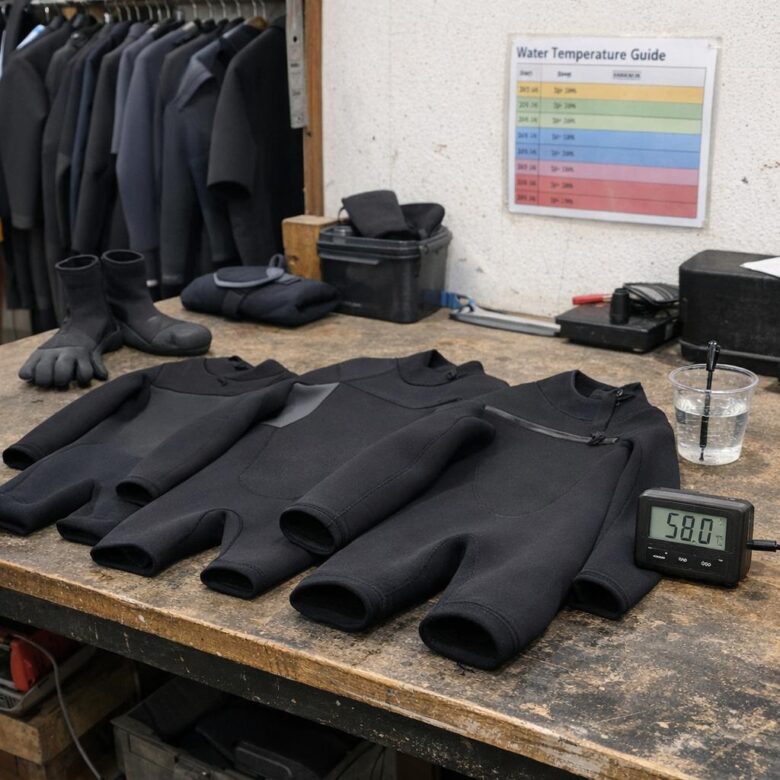
Manufacturer charts do not agree perfectly because products, testing methods and intended users differ. The ranges below are broad surf-oriented starting points, not guarantees of comfort or safety.
| Water temperature | Common starting options | Reasons you may need more protection |
|---|---|---|
| Above about 21°C / 70°F | Swimwear, surf top, thin vest, 1–2mm top or springsuit depending on conditions | Strong wind, long sessions, repeated immersion, sun protection or sensitivity to cold |
| About 18–21°C / 64–70°F | 2mm springsuit or 3/2 full suit | Cold mornings, exposed coastline, long waits between sets or low personal tolerance |
| About 15–18°C / 59–64°F | 3/2 full suit is common; some surfers prefer a 4/3 | Wind, long sessions, older or worn suit, frequent flushing or colder air |
| About 12–15°C / 54–59°F | 4/3 full suit, with accessories considered according to conditions | Cold extremities, dawn sessions, strong wind or extended exposure |
| About 8–12°C / 46–54°F | 5/4, 5/4/3 or hooded cold-water suit, commonly with boots and gloves | Local winter conditions, long sessions and individual response may require a heavier system |
| Below about 8°C / 46°F | Specialized cold-water setup, potentially 6/5 or similar with hood, boots and gloves | Cold-water experience, local guidance, shorter sessions and a reliable exit plan become especially important |
Six factors can move you away from the chart
Wind
Wind can increase heat loss above the water, especially while sitting, walking back to the car or changing afterward.
Session duration
A suit that feels comfortable for 40 minutes may be insufficient for a much longer session.
Suit condition
Compressed foam, stretched openings and failing seams can make an older suit colder than a new model with the same label.
Body shape and fit
Gaps around the lower back, neck or underarms can permit water movement that reduces warmth.
Wave activity
Repeated duck dives and wipeouts may create more flushing than a calm session with limited submersion.
Personal response
Previous cold-water experience is more useful than assuming everyone should wear the same equipment.
A thicker suit is not always the solution. When a 5/4 is badly fitted but a 4/3 seals correctly and allows better movement, the thinner suit may feel warmer during real use.
Fit is the most important in-store test
A new wetsuit should feel close and supportive when dry. It may feel tighter than normal clothing, but it should not cause pain, prevent a full breath or create numbness.
Perform these movements before buying
Signs of a promising fit
- Close contact through the torso and lower back
- No large air pockets or hanging material
- Neck, wrist and ankle openings lie flat
- Shoulders can complete repeated paddle movements
- Knees and hips bend without painful pulling
- Normal breathing remains comfortable
Signs to try another size or cut
- Large folds around the back, chest or underarms
- An open gap at the neck when standing normally
- Painful pressure across the throat or chest
- Numb hands or feet during a short fitting
- The crotch cannot be pulled fully into position
- Shoulder movement feels severely restricted
Size labels are not consistent between brands. A medium in one company may fit differently from a medium in another. For a first purchase, trying several brands in person is usually more useful than ordering from height and weight alone.
Do not buy an oversized wetsuit for a child to grow into
Extra room can allow more water to circulate through the suit and create folds that interfere with movement. A child’s wetsuit should fit the body currently wearing it, using the manufacturer’s youth measurements and an in-person movement check where possible.
Check neck comfort, shoulder movement, torso length and whether the child can put on and remove the suit with appropriate assistance. Replace the suit when growth makes it restrictive rather than beginning with a substantially oversized model.
Seam construction changes warmth, flexibility and price
The panel edges are overlapped and stitched through. This creates a flexible and durable seam, but water can pass through the stitch line. Flatlock construction is commonly used in warmer-water suits.
The panels are glued and the stitching does not normally pass completely through the material. This reduces water penetration and is common in cooler-water full suits.
Tape may reinforce selected high-stress seams or the complete internal seam network. It can improve durability and water resistance, although construction quality still varies.
Some premium cold-water suits add external or internal sealing systems intended to reduce water movement. Inspect these areas carefully because cracked or lifting seal material can affect performance.
No seam system makes a surfing wetsuit equivalent to a drysuit. A wetsuit is intended to insulate while allowing some water inside; its fit and construction help limit how freely that water exchanges.
Choose the entry system around mobility and ease of use
Back zip
The large opening can make dressing easier, particularly for beginners or surfers with limited shoulder mobility.
Some designs may permit more flushing around the zip, although internal barriers and modern closures can reduce it.
Chest zip
The smaller upper opening can improve sealing and leave the back panel free from a long rigid zip.
It generally requires more flexibility and correct technique when putting the suit on or taking it off.
Zipperless
Removing the main zip can provide a flexible feel, but the opening may be difficult for some surfers to use.
Do not choose it only because it is marketed as advanced. Make sure you can dress without overstretching the entry.
The best system is the one you can close correctly without damaging the suit or exhausting yourself. A theoretically warmer closure has little value when it cannot be positioned and sealed properly.
Hoods, boots and gloves are part of the system
Can reduce heat loss around the head and limit cold flushing at the neck. Integrated and detachable designs seal differently.
Add insulation and may protect the feet during certain entries, but thickness, sole type and fit affect board feel.
Help protect the hands in cold water, although thicker models can increase forearm fatigue and reduce dexterity.
Accessories should fit closely without restricting circulation. Water-filled gaps around boots or gloves can reduce their usefulness, while equipment that is too tight can cause pain or numbness.
Thermal linings can help, but labels are difficult to compare
Manufacturers use different names for internal fabrics intended to improve warmth, water management or drying time. There is no universal rating that allows every lining to be compared directly.
When comparing two suits, consider:
-
Where the lining is placed
Torso-only coverage is different from lining through most of the suit. -
How the lining affects flexibility
Additional material should not make paddling unreasonably difficult. -
Drying and care requirements
Thick linings may take longer to dry in a humid room or during travel. -
The complete suit construction
Fit, seams and openings may matter more than one premium fabric name.
What to wear underneath
Many surfers wear swimwear alone underneath a wetsuit. The choice should avoid bulky seams, metal hardware and material that bunches under the suit.
A thin rash guard can make changing more comfortable or reduce friction for some people, but it may also create folds when the wetsuit already fits closely. Thermal layers should be designed for use beneath a wetsuit and should not interfere with seals or movement.
Avoid ordinary cotton clothing. It can bunch, retain water and create uncomfortable pressure points.
Inspect a used wetsuit before treating it as a bargain
Old neoprene can lose performance without a dramatic tear
Insulating foam can become compressed, stiff or stretched through age, heat and repeated use. A used suit may fit differently from the same model when new.
Try the complete suit on when possible. Check whether it still returns to shape and whether the seals remain close to the neck, wrists and ankles.
- Cracked or stiff material
- Flattened torso panels
- Loose or stretched seals
- Open stitching
- Lifting internal tape
- Damaged zip teeth
- Failed knee panels
- Poorly repaired tears
Ask how the suit was dried and stored. Long periods in direct sun, a hot vehicle or on a narrow hanger can shorten its useful life.
Follow a deliberate buying sequence
Care determines how long warmth and flexibility last
Remove salt, sand and residue from both sides after the session.
Use ventilation and avoid direct sunlight, heaters and clothes dryers.
Follow the label and use a broad hanger or support the suit across the waist.
Do not leave it wet, tightly compressed or inside a hot vehicle.
Do not put a wetsuit in a washing machine or tumble dryer. Avoid hot water and general household chemicals unless the manufacturer specifically approves them. Use a dedicated wetsuit cleaner when required by the care instructions.
Take the suit off on a changing mat, towel or another clean surface rather than standing on rough pavement. Pull gradually and avoid digging fingernails into the material.
There is no fixed replacement date
A wetsuit’s useful life depends on material, frequency of use, stretching, heat exposure, storage, fit and repairs. Replace or professionally assess it when deterioration prevents it from performing as intended.
- Large areas remain stretched and no longer contact the body.
- The suit has become unusually stiff around the shoulders or knees.
- Seams repeatedly reopen or allow substantial flushing.
- Internal tape is lifting across several important areas.
- The zip no longer closes or remains secure.
- Neck, wrist or ankle seals are badly torn or permanently loose.
- The material is cracking, crumbling or thinning extensively.
- The suit no longer keeps you warm in conditions it previously handled.
A small compatible repair may extend the life of a suit. Widespread deterioration, failing foam or several major seam problems may make replacement more practical.
Common wetsuit-buying mistakes
- Choosing only from one water-temperature chart.
- Buying the same size used in a different brand without trying it on.
- Accepting severe shoulder restriction because the suit is expected to feel tight.
- Buying oversized equipment for a child to grow into.
- Assuming a more expensive suit must be warmer for your body.
- Ignoring wind, session duration and the suit’s current condition.
- Choosing a zipperless model that is difficult to put on correctly.
- Using thick accessories that restrict circulation or board feel.
- Buying used without inspecting seams, seals and foam flexibility.
- Leaving no budget for boots, gloves or a hood when local winter conditions require them.
Final fitting and purchase checklist
For the rest of your beach equipment, use the Didsurf beginner surf gear checklist. Travelers should also review the surf trip safety checklist before relying on unfamiliar rental equipment.
The right wetsuit is a complete system
Choose thickness from the water and conditions in which you genuinely expect to surf. Then test whether the suit seals closely while preserving breathing, shoulder movement and a comfortable takeoff position.
Seams, entry system, lining, hood, boots and gloves can improve warmth, but they must work together. More material is not always better when it creates fatigue, poor circulation or restricted movement.
A properly fitted mid-range suit is often a better purchase than a premium suit in the wrong size. Try several cuts, read the exact manufacturer specifications and leave the water whenever cold begins to affect coordination or judgment.
Frequently asked questions
Should a wetsuit feel very tight in the shop?
It should feel close and supportive, but it should not cause pain, prevent a full breath, create numbness or severely restrict shoulder and hip movement. Another size or brand may fit your proportions better.
Is a 3/2 wetsuit suitable for every surfer in 18°C water?
No. A 3/2 is a common starting point around that range, but wind, session length, fit, suit condition and personal cold tolerance may make a 4/3 more appropriate for some surfers.
Does a thicker wetsuit always keep you warmer?
Not always. Thickness increases insulation, but poor fit and repeated flushing can make a thick suit feel cold. Excessive thickness can also restrict paddling and increase fatigue.
Is a chest-zip wetsuit always warmer than a back zip?
No. Chest zips often reduce the size of the entry opening, but modern back-zip suits may include effective internal barriers. Fit, seams, materials and correct closure also influence warmth.
Can I use one wetsuit all year?
It depends on the local seasonal range. A single suit may cover much of the year in a mild climate, while locations with large temperature changes may require separate warm- and cold-water setups.
Should I buy a used wetsuit?
A used suit can offer value when it still fits correctly and the foam, seams, seals and zip remain in good condition. Old compressed material may be colder and less flexible even without a large visible tear.
Can a wetsuit replace a life jacket?
No. Wetsuits provide some buoyancy, but they are not substitutes for activity-appropriate flotation equipment, swimming ability, supervision or safe conditions.
Wetsuit fit, construction and cold-water references
- Surfing England: choosing wetsuit fit and thickness
- Surfing England: surf equipment and close-fitting wetsuit guidance
- O’Neill: thickness, entry systems and seam construction
- Rip Curl: wetsuit insulation, fit and mobility
- O’Neill: washing, drying and storage instructions
- RNLI: cold-water shock and suitable thermal protection
Temperature recommendations, material names, panel thicknesses, sizing and care instructions vary between manufacturers and models. Follow the specifications supplied for the exact wetsuit and verify current local water conditions before every session.