A first surf trip should not be planned around the most famous wave you can afford to reach. It should be planned around the conditions in which you can realistically surf, the support available when conditions change and the complete cost of getting into the water.
A destination may look beginner-friendly in promotional photographs but receive powerful seasonal swell, have limited sandy access or require daily transport to a suitable teaching beach. Another location may be less famous but offer better rentals, qualified instruction, lifeguard coverage and several sheltered alternatives.
The aim is not to predict a perfect week. It is to build a trip that still works when the forecast changes, your equipment is delayed or your body needs a rest day.
Write a trip brief before searching for destinations
Search results become more useful when you know what the trip needs to provide. A beginner looking for supervised whitewater practice should not use the same destination criteria as an experienced surfer traveling with several boards.
Record whether you need assistance, catch broken waves independently or are beginning to surf small unbroken waves.
Decide whether you need a first lesson, several group sessions, private coaching or local guidance for unfamiliar breaks.
Include the needs of non-surfers, children, older relatives or anyone who requires different accommodation and activities.
Define whether you are comfortable with a dormitory, shared bathroom, private room, kitchen or family-oriented property.
Choose whether you intend to rent locally, travel with a board or decide only after checking airline and rental conditions.
Set one limit covering transport, accommodation, lessons, rentals, food, insurance, fees and an emergency reserve.
Choose the destination through five filters
Look for several places where your current skill can be practised safely. A sandy bottom can be more forgiving than shallow reef, but it does not automatically remove rip currents, shore break or crowd-related risk.
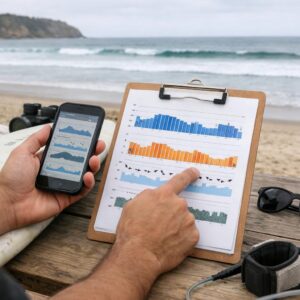
Research the typical swell direction, wind, rainfall, water temperature, storm exposure and crowd level during your actual dates. A beach can change significantly between seasons.
Check for reputable surf schools, appropriate rental boards, lifeguarded beaches where available, transport and nearby medical services.
A useful destination has more than one suitable beach, or worthwhile activities for days when surf, wind, weather or fatigue prevent a session.
Include entry requirements, transfer time, local transport, language, payment access, communication coverage and the cost of reaching the teaching beach.
Look for practical signs of beginner suitability
A fixed wave-height label such as “waist high” cannot guarantee beginner suitability. Wave power, period, current, bottom shape, crowd, takeoff area and individual ability also matter.
Before choosing a coastline, use our guide on reading surf forecasts before choosing a beach.
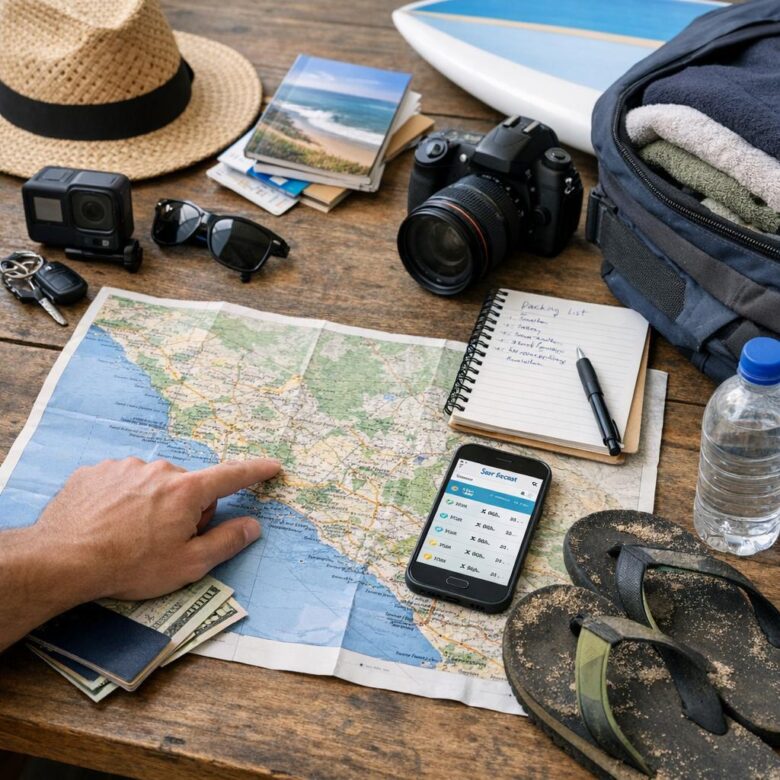
Plan in stages instead of making every booking at once
Check passport validity, visas or travel authorizations, destination advisories, local laws, health information, seasonal conditions and your realistic total budget.
Contact schools, camps or rental shops. Confirm qualifications, lesson format, equipment, transportation, cancellation terms and what happens during unsuitable surf.
Save confirmations, arrange suitable insurance, document valuable equipment, plan airport transfers and keep accessible copies of important information.
Review official travel information, weather, swell, transport notices and airline policies. Do not rely on screenshots or rules saved months earlier.
Speak with the school or lifeguards, observe the beach and begin with conditions that allow you to learn the location gradually.
Build the budget around the complete trip
A cheap flight can lead to an expensive surf week when the airport is far from the coast, boards attract oversized baggage fees and every suitable beach requires private transport.
| Budget category | Costs commonly missed | What to verify |
|---|---|---|
| Flights | Seat, payment, checked baggage, surfboard and connection-related charges | Final itinerary-specific price and baggage rules for every operating airline |
| Accommodation | Cleaning, service, local, environmental or facility fees | Final mandatory total for your room and occupancy |
| Surfing | Lessons, guiding, wetsuit, board, damage deposit and beach transport | Exactly which sessions and equipment are included |
| Ground transport | Airport transfer, taxi, rental vehicle, fuel, parking and road fees | Whether the suitable surf beach is walkable from the accommodation |
| Food | Drinking water, remote-location prices and special dietary charges | Which meals are included and what is available nearby |
| Travel protection | Medical, evacuation, cancellation and equipment cover | Whether recreational surfing and your planned activities are covered |
| Contingency | Replacement rental, extra night, changed transfer or medical expense | An accessible reserve suitable for the destination’s remoteness |
Our comparison of surf camps and surf resorts explains how to compare package value instead of using the nightly room price alone.
Decide whether to rent or fly with your board
Renting locally may be better when:
- You are still learning which board dimensions suit you.
- The school includes appropriate equipment.
- Airline and transfer charges are high.
- You will use several teaching beaches.
- You want local staff to select a board for the conditions.
- The rental shop guarantees suitable beginner stock.
Bringing your board may be reasonable when:
- You already surf it confidently.
- Suitable rentals are limited or uncertain.
- The complete baggage cost is acceptable.
- You have a protective travel bag and packing plan.
- Ground transport can carry the board safely.
- Your insurance and airline terms are understood.
Check the airline before buying the ticket
Sports-equipment rules can differ by airline, route, aircraft, fare class and loyalty status. A policy found through a search engine may not apply to the itinerary you are purchasing.
Confirm these details in the airline’s current policy
Photograph the board, fins and packed bag before check-in. Keep baggage receipts and inspect the equipment before leaving the airport. When damage or missing contents are discovered, report them to the airline promptly and request written documentation.
Verify documents, entry rules and health preparation
Passport, visa, travel authorization and health requirements vary by citizenship, destination, transit country and trip length. Confirm them through the destination’s embassy, immigration authority and official government travel information.
Passport and immigration
Check validity requirements, blank pages, visas, electronic authorizations, return-ticket rules and any documents required when traveling with a child.
Destination-specific preparation
Review official health guidance for recommended or required vaccines, medicines, food and water risks, mosquito exposure and access to medical care.
Legal and practical access
Check whether your medication is permitted, carry it in labeled packaging and bring the documents required by the destination and transport provider.
Read the insurance policy, not only the product name
A policy described as comprehensive, sports-friendly or adventure travel insurance may still exclude surfing in certain conditions, competitions, professional activity, unattended equipment or pre-existing medical issues.
- Is recreational surfing covered? Check lessons, independent surfing, guided sessions and the destinations included.
- Are medical treatment and evacuation covered? Review limits, deductibles, payment procedures and remote-area exclusions.
- What cancellation reasons qualify? Bad surf alone is unlikely to be covered unless the written policy specifically says so.
- Is surfboard damage or loss included? Check valuation, depreciation, packing requirements and airline-related exclusions.
- Are rental costs covered during a baggage delay? Confirm whether replacement equipment is eligible and which receipts are required.
- What must be reported immediately? Police, airline, medical or property reports may be required before a claim is accepted.
Insurance provides financial protection for events covered by the contract. It does not make an advanced break, remote coastline or severe forecast appropriate for a beginner.
Book the surf school as carefully as the accommodation
Local knowledge is valuable only when it comes with responsible instruction
Ask which coaching and water-rescue standards the school follows. There is no single worldwide instructor licence, so request the name of the organization that issued the qualification.
A responsible provider should ask about swimming confidence, previous surfing experience, age, injuries and relevant health concerns. It should also be willing to relocate, adapt or cancel when conditions are unsuitable.
- Instructor qualifications
- Water-rescue training
- Students per instructor
- Equipment included
- Lesson beach
- Transport arrangements
- Cancellation policy
- Plan for unsuitable surf
Use our complete guide to checking beginner surf lessons before booking.
Choose accommodation by the actual daily route
“Beachfront” does not necessarily mean that the beach in front of the property is suitable for your level. A beginner may still need daily transport to a different bay or teaching area.
Check the real walking or driving route, including hills, unsafe roads and board transport.
Ask whether boards can be stored securely without prolonged sun, heat or pressure damage.
Confirm whether there is a ventilated place for wet equipment rather than relying on the bedroom.
Review meal times, shops, dietary options and the cost of reaching restaurants.
Check whether the location remains practical when you are not surfing.
Read deposit, early-departure, date-change and refund conditions before paying.
Pack in three layers
Keep the trip moving
- Passport and required entry documents
- Insurance details
- Booking confirmations
- Emergency contacts
- Medication documents
- Offline copies of important information
Bring what must fit you
- Swimwear
- Rash guard or suitable surfwear
- Water-resistant broad-spectrum sunscreen
- Personal medication
- Reusable water bottle
- Dry clothes and compact towel
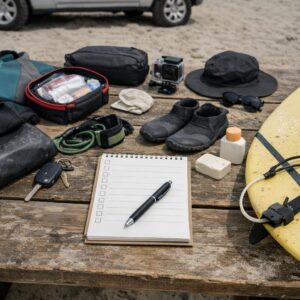
Pack only what is justified
- Board and fins when bringing your own
- Inspected surf leash
- Correct wax when required
- Wetsuit suited to the conditions
- Small compatible tool kit
- Protective board bag
Do not rely only on the phrase “reef-safe” when choosing sunscreen. Check the label, active ingredients, water-resistance instructions and environmental rules at the destination. Protective clothing and shade reduce dependence on sunscreen alone.
Our beginner surf gear checklist separates essentials from condition-dependent equipment.
Do not make arrival day your most demanding surf day
Learn the local system before joining the lineup
General surf etiquette is useful, but access routes, designated areas, hazards and crowd patterns vary by break. Observe first and ask for local guidance.
Beach flags and their meanings vary between countries. Follow the signs and instructions displayed at the location rather than assuming the system is identical to the one used at home.
Leave room for recovery and non-surf days
A packed schedule can reduce the value of the trip when fatigue affects paddling, reaction time and board control. Beginners use unfamiliar muscles and may need more recovery than expected.
Flexible surf window
Avoid attaching every lesson to one exact day when the provider offers reasonable flexibility around conditions.
Recovery plan
Include sleep, hydration, food, shade and time away from repeated paddling and sun exposure.
Alternative activities
Choose options that make the trip worthwhile without pressuring you to surf unsuitable conditions.
Pain, injury, illness, cold, dehydration and exhaustion are reasons to stop and obtain appropriate assistance. A travel itinerary should not override your physical condition.
First surf trip warning signs
- The destination is selected only because of one famous advanced wave.
- The package guarantees good waves or daily surf regardless of conditions.
- The school will not explain instructor or water-rescue qualifications.
- Suitable beginner equipment cannot be reserved or confirmed.
- The accommodation is advertised as beachfront, but the teaching beach is far away.
- Mandatory fees appear only after most booking details have been entered.
- The airline policy for surfboards cannot be confirmed for the actual itinerary.
- The insurance provider will not confirm surfing coverage in writing.
- The cancellation policy does not explain what happens during unsuitable surf.
- The itinerary has no rest day, alternative beach or non-surf plan.
- You need to rely on an unfamiliar reef or remote beach to surf at all.
- The trip budget has no room for medical, transport or baggage disruption.
Final pre-departure checklist
A successful first surf trip is adaptable
Choose a destination that offers several realistic ways to surf at your current level. Confirm qualified instruction, suitable rentals, travel documents, health preparation, insurance and the complete cost before paying.
Renting can be smarter than flying with a board. A quiet teaching beach can be more useful than a famous peak. One well-timed lesson can provide more value than several unsupervised sessions in conditions you do not understand.
The best plan is not the one that forces the original itinerary to happen. It is the one that allows you to change beaches, rest, take instruction or stay out without turning the whole trip into a failure.
Frequently asked questions
What is the best destination for a first surf trip?
There is no universal destination. Look for seasonal conditions suited to your ability, several teaching beaches, reputable instruction, suitable rentals, reasonable emergency access and a workable total budget.
Should a beginner bring a surfboard?
Renting is often more practical when you are still identifying the right board. Bring your own only after comparing airline, transfer, packing and rental costs and confirming that the board suits the destination.
How many surf lessons should I book?
The answer depends on your skill, trip length and lesson structure. Start with enough instruction to understand the local beach, safety process and equipment. Avoid a large non-refundable package before evaluating the provider.
Does travel insurance normally cover surfing?
Coverage varies. Some policies include recreational surfing, while others restrict locations, competitions, equipment or medical circumstances. Read the policy and request written clarification from the insurer.
Should I book during the main surf season?
Not automatically. The main swell season may produce conditions beyond a beginner’s ability. Research the specific coastline and ask local schools which period generally offers appropriate teaching opportunities.
Is a surf camp easier than planning independently?
It can simplify lessons, rentals, accommodation and transport, but packages vary. Check the exact inclusions, coaching standards, room type, schedule and cancellation policy.
What should I do when conditions are too advanced?
Do not enter. Ask whether the school can relocate or reschedule, choose a more sheltered appropriate beach, take a land-based lesson or use the day for recovery and another activity.
Travel, health and surf-safety references
- U.S. Department of State: international travel checklist and entry-document planning
- U.S. Centers for Disease Control and Prevention: preparation before international travel
- CDC Travelers’ Health: traveling abroad with medication
- U.S. Department of Transportation: lost, delayed and damaged baggage guidance
- International Surfing Association: coaching and water-safety training pathways
- RNLI: surfing and coastal safety guidance
- RNLI: beach flags and signs
Entry requirements, health advice, airline rules, insurance cover and coastal safety systems vary by destination and can change. Verify information through the authorities, airline, insurer and providers responsible for your actual trip.