A beginner surf lesson should do more than help you stand on a board. It should introduce the ocean gradually, explain the risks clearly, and give you enough individual attention to learn without being rushed.
The cheapest or most heavily advertised lesson is not automatically the best choice. Instructor training, local knowledge, group size, equipment condition, beach selection, cancellation rules, and the way a school responds to changing conditions all matter.
This guide explains the practical checks worth making before you pay, along with the warning signs that suggest a surf school may not be a good fit.
What a well-run beginner lesson should include
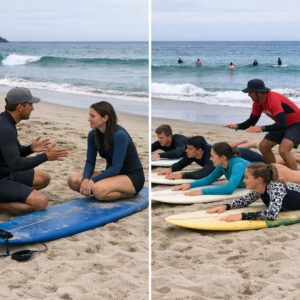
A professional lesson normally begins before anyone enters the water. The instructor should introduce the location, identify the area being used, explain how the board and leash work, discuss hazards, and show the basic movements on land.
The exact structure will depend on the beach, local rules and the students, but a beginner session should generally include:
- A brief assessment of swimming confidence, previous surfing experience, injuries and relevant medical concerns.
- An explanation of the day’s conditions, including waves, currents, wind, tide and any beach-specific hazards.
- Clear instructions about where students may and may not enter the water.
- Guidance on board handling, falling safely, protecting the head and avoiding collisions.
- Land-based practice for paddling position, getting to the feet and maintaining a stable stance.
- Active supervision in an area selected for beginner ability rather than convenience.
- A plan for stopping, relocating or changing the lesson if conditions deteriorate.
Not every first lesson needs deep water or unbroken waves. Many beginners learn more effectively in shallow, manageable white water, where they can practise board control and repeated takeoffs without dealing with a busy lineup.
How to check instructor credentials without relying on vague claims
There is no single surf-instructor licence that applies in every country. Requirements differ between national federations, local authorities, beaches, insurers and surf-school accreditation programs.
Instead of asking only whether an instructor is “certified,” ask which organization issued the qualification and whether it is current. Recognized pathways may include training from the International Surfing Association, a national surfing federation or another established coaching organization in the country where the lesson takes place.
Coaching training and water-safety training are not always the same qualification. A strong instructor profile may include:
- A recognized surf-instruction or coaching qualification appropriate for beginner lessons.
- Current aquatic rescue, lifesaving or surf-rescue training.
- Current first-aid and CPR training where required or available.
- Knowledge of the specific beach, its changing hazards and local emergency procedures.
- Appropriate safeguarding checks or training when working with children.
The International Surfing Association states that its accredited instructors must maintain recognized water-safety accreditation. Its water-safety pathway includes rescue skills, basic emergency care and CPR assessment. That does not make ISA certification the only acceptable route, but it provides a useful example of what structured training can involve.
A school should be able to answer credential questions without becoming defensive. You do not necessarily need to request copies of every certificate before a casual lesson, but the business should clearly identify the standards it follows.
Group size matters more than a low headline price
Smaller groups usually allow more direct instruction, quicker corrections and closer supervision. However, there is no universal student-to-instructor ratio that is ideal for every lesson.
A suitable ratio depends on:
- The students’ ages and swimming confidence.
- The beach, wave size, currents and water depth.
- Whether assistants are present in the water.
- The difference in ability between participants.
- Whether the session is a first lesson or a progression class.
Some registered surf-school standards permit groups of several students per coach, but a maximum permitted ratio is not automatically the best ratio for a nervous first-timer. Ask how many students will be assigned to each instructor during the water portion of the lesson, not only how many people can join the booking.
| Situation | Lesson format worth considering | Why it may help |
|---|---|---|
| Confident adult beginner | Small group lesson | Usually offers a balance between cost, social atmosphere and individual feedback. |
| Nervous in open water | Private or very small group | Allows the instructor to adapt the pace and remain closer to the student. |
| Young child | Age-specific private or small group lesson | Provides closer supervision and teaching suited to the child’s size and attention span. |
| Different ability levels together | Separate groups where possible | Prevents advanced participants from setting a pace unsuitable for complete beginners. |
| Returning beginner | Group or semi-private coaching | Can focus on timing, positioning and repeated practice rather than a full first-lesson introduction. |
Inspect what equipment is included
Most beginner lessons use large soft-top surfboards because their volume improves stability and their padded surfaces are generally more forgiving than traditional hard boards. The correct board is not necessarily the longest board available; it should suit the student’s size, mobility and the conditions.
Before booking, confirm whether the advertised price includes:
- A beginner-appropriate surfboard selected for your approximate height, weight and ability.
- A correctly attached leash in suitable condition.
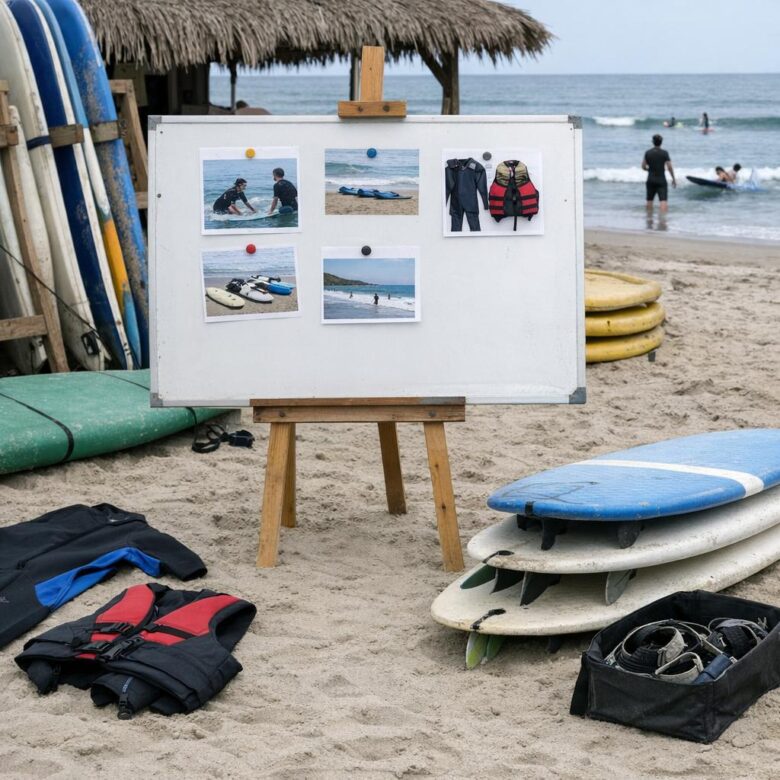
- A wetsuit or rash guard when appropriate for the local water temperature and climate.
- Any required protective equipment for the location or type of lesson.
- Use of the equipment for the full advertised lesson period.
Wetsuits should fit closely without preventing normal breathing or movement. A suit that is extremely loose may allow excessive water flushing, while one that is painfully tight can make paddling and breathing uncomfortable.
Equipment should look maintained rather than merely available. Cracked leash swivels, damaged cords, loose fins, deep board damage or badly torn wetsuits are reasons to ask for a replacement.
How the school should choose the beach and lesson time
A booking time is not a guarantee that the lesson should proceed exactly as planned. Tide, swell, wind, currents, crowd levels and beach access can change between the day of booking and the start of the session.
Forecast websites can help with planning, but they do not replace a local assessment. The instructor should check the actual beach and be prepared to change the meeting time, move to another approved location or cancel when conditions are inappropriate.
For beginners, a suitable teaching area usually offers:
- Manageable waves suited to the group’s ability.
- Enough space to reduce collision risk.
- A safe entry and exit route.
- No known hazard that the group cannot reasonably manage.
- Access to lifeguard or emergency support where available.
On lifeguarded beaches, surfers should understand and follow the local flag system. Flag meanings and designated areas may vary by country, so follow the signs and instructions displayed at that beach rather than assuming that rules are identical everywhere.
Private lesson or group class: which is better?
Group lesson
Often the more affordable option and a comfortable introduction for people who enjoy learning with others.
- Usually costs less per person.
- Can feel social and less intense.
- Works well when abilities are similar.
- May involve more waiting between corrections.
Private lesson
Provides more individual attention and can be easier to adapt around confidence, mobility or specific goals.
- More direct feedback and supervision.
- Pace can be adjusted more easily.
- Useful for nervous beginners or children.
- Usually costs considerably more.
A private lesson is not automatically higher quality. An attentive group instructor at a well-run school may offer a better experience than an unprepared private instructor. The qualification, lesson plan and conditions remain more important than the label attached to the session.
Questions to ask before paying
A clear response to a few practical questions can reveal more than a polished booking page. Contact the school if important details are missing.
The answers do not need to be long, but they should be specific. “Our instructors are experienced” is less useful than naming the training standard, explaining the water-safety qualification and stating the group ratio.
Understand the price, waiver and cancellation policy
Compare the complete cost rather than the amount displayed in the largest font. A lesson that appears inexpensive may exclude a wetsuit, board hire, taxes, photographs, booking fees, parking or transport.
Read the cancellation terms before paying. Ocean-based lessons are affected by conditions, and a fair policy should explain what happens when:
- The school cancels because the conditions are unsafe.
- The lesson is moved to another time or location.
- You become ill or cannot attend.
- You arrive late and miss the safety briefing.
- Travel disruption prevents you from reaching the meeting point.
You may also be asked to sign a participation waiver. Read it rather than treating it as a routine checkbox. A waiver does not remove the need for the school to follow applicable safety duties and consumer laws, but the legal effect varies by location.
Travel insurance or general vacation insurance may exclude surfing, lessons, equipment damage or higher-risk activities. Check the policy directly with the insurer instead of assuming you are covered.
Warning signs that deserve a closer look
- The school guarantees that every beginner will stand up, catch a certain number of waves or progress within one session.
- The booking page gives no information about instructors, safety training, group sizes or what equipment is included.
- Staff dismiss questions about water safety or cannot explain how conditions are assessed.
- The school continues a beginner lesson in clearly unsuitable conditions simply because the booking is already paid.
- Students are taken directly into the water without a safety explanation or basic equipment guidance.
- Equipment appears damaged, poorly fitted or inappropriate for beginners.
- The meeting point, lesson duration and cancellation terms remain unclear after payment.
- Children are placed in large mixed-age groups without clear supervision or safeguarding information.
- Reviews repeatedly mention overcrowding, last-minute hidden fees or lessons being rushed.
One negative review does not prove that a business is unsafe, just as a high star rating does not prove that every instructor is suitable. Look for repeated patterns and detailed comments rather than relying only on the overall score.
Special considerations for children and families
A children’s surf lesson should not simply be an adult group with smaller boards. Ask whether the instructors regularly teach the child’s age group and how the school handles supervision, changing areas, parental presence, medical information and emergencies.
Parents or guardians should confirm:
- The minimum age and swimming requirements.
- The instructor-to-child ratio used in the actual conditions.
- Whether a parent must remain nearby.
- What safeguarding procedures and background checks apply locally.
- How medication, allergies or additional needs should be communicated.
- Whether the lesson can be adapted if the child becomes cold, tired or frightened.
A child should not be pressured to enter or remain in the water to avoid “wasting” the booking. A positive first experience can consist of learning beach safety, handling a board and practising in shallow water.
What to do on the day of your first lesson
After the session, rinse hired equipment if the school asks you to, return all items, and report any damage or injury. Ask the instructor what skill to practise next rather than immediately buying advanced equipment.
A practical booking checklist
| Check | Positive sign | Reason to ask more questions |
|---|---|---|
| Instructor | Named coaching and water-safety standards | Only vague claims such as “professional” or “expert” |
| Group | Clear number of students per instructor | No limit stated or heavily crowded sessions |
| Conditions | Flexible plan to relocate, postpone or cancel | Lesson proceeds under all conditions |
| Equipment | Soft boards and properly fitted gear are included | Equipment details are missing or visibly damaged |
| Price | Complete cost explained before checkout | Extra rental, booking or beach fees appear later |
| Safety | Beach briefing and emergency procedures are explained | Focus is only on standing up quickly |
| Cancellation | Written policy covers unsafe conditions | No refund, credit or rescheduling information |
Final recommendation
The best beginner surf lesson is the one that matches your current ability and treats ocean awareness as part of learning to surf. Look beyond the headline price and check the instructor’s training, group structure, equipment, beach choice and cancellation policy.
A responsible school will not be offended by reasonable safety questions. It will explain what is included, ask about your experience, adapt the lesson to the conditions and avoid promising instant results.
Your first lesson does not need to end with a perfect ride to be worthwhile. Learning how to handle the board, identify the safe teaching area, fall with more control and understand the instructor’s signals are meaningful first-session outcomes.
Frequently asked questions
Do I need to know how to swim before taking a surf lesson?
Swimming requirements vary by school and lesson location, but you should disclose your actual ability before booking. Surfing involves moving water, falls and separation from the board. A lesson provider should explain its minimum requirements and decide whether the chosen conditions are appropriate.
Is one surf lesson enough to learn?
One session can introduce safety, board handling, paddling position and the basic takeoff movement. Consistent control, wave selection and independent surfing usually require further supervised practice. Progress varies according to fitness, conditions, instruction and time in the water.
Should a beginner book the earliest lesson of the day?
Not automatically. Morning conditions are sometimes cleaner or less crowded, but tide, swell, weather and the local beach matter more than a general rule. Ask the school why it recommends a particular time for beginners.
Are surf lesson photos worth paying for?
Photos can be a useful memory, while video may help with technique review. They are optional extras rather than a measure of lesson quality. Confirm the price, delivery method, privacy terms and whether media time reduces instruction time.
What happens when the waves are too large?
A responsible school should reassess the location and may move, postpone or cancel the session. The available refund or credit will depend on the written policy. Beginners should not be pressured into unsuitable conditions because of scheduling or payment concerns.
Safety references
Local rules, instructor requirements and beach flag systems vary. Check the national surfing federation, lifesaving organization or coastal authority for the country where the lesson will take place.